PART VI
THE BOUTIQUE VORTEX
CHAPTER 48
FROM DEFINITION TO PRESSURE
The Boutique Vortex grew out of a direct analytical need.
The definition I established in Chapter 45 is layered because the evidence is layered. It identifies four areas that have to remain materially present: Identity, Operations, Production and Control, and Market Perception and Access. But identifying those conditions does not tell us what happens to them as a company grows, changes ownership, expands distribution, builds infrastructure, alters production relationships, or becomes more visible in the market. A definition is static; companies are not.
I did not need another definition or a scoring system. I needed a way to see what happens when real-world pressures act on the four conditions. Growth can strengthen one area while weakening another; infrastructure can protect production discipline while creating institutional demands; wider distribution can improve access while changing discovery; ownership can change without immediately changing production authority.
Those movements were already present throughout the twenty questions. The Vortex did not create them; it gave me a way to organize them. The definition identifies the conditions I require. The Vortex shows how those conditions can reinforce, weaken, or separate under pressure.
CHAPTER 49
THE BOUTIQUE VORTEX
The Boutique Vortex is an interpretive model built around the same four areas identified in my definition: Identity, Operations, Production and Control, and Market Perception and Access. Each captures a different part of what the premium cigar industry routinely compresses into the single word boutique.
The model does not produce an automatic yes-or-no answer. A company may retain strong principal identity while its operations become more developed. It may preserve extraordinary production discipline while increasing output. It may become more widely distributed while remaining unusually close to retailers and consumers. Ownership may change while substantial decision-making authority remains close to the cigar. The reverse can happen as well: a company can remain privately owned while the cigar gradually becomes subordinate to inventory requirements, release schedules, financial pressures, or the demands of a larger operation.
Those combinations are not exceptions to the model; they are the reason the model exists.
HOW TO READ THE VORTEX
The Vortex is not a scoring system. None of the four areas receives a universal numerical weight, and there is no formula in which three strong categories can compensate automatically for a fourth that has largely disappeared.
When analyzing an enterprise, I begin by identifying what is being classified: the company or brand, or a particular cigar or production. Then I examine the evidence across each of the four areas:
Identity: Measures whether recognizable authorship, purpose, principal involvement, voice, culture, history, community, or point of view remains meaningfully attached to the company or cigar.
Operations: Examines how the organization functions and how much meaningful discretion remains over consequential decisions. Staffing, infrastructure, distribution, logistics, inventory, administrative systems, ownership context, market reach, and retailer support all matter. The core question is whether the operating structure still allows the people responsible for the cigar to make cigar-first decisions when commercial or institutional pressures push in another direction.
Production and Control: Identifies where meaningful authority and accountability over the cigar actually reside. Tobacco knowledge, blend authority, factory relationships, fermentation, aging, manufacturing involvement, quality control, consistency, and the ability to delay, change, or stop a project all belong here. Factory ownership can create control, but ownership and authority are not identical.
Market Perception and Access: Measures how the company or cigar is experienced outside its own walls. Recognition, availability, retail presence, scarcity, media attention, discovery, reputation, events, consumer interaction, proximity, selectivity, and perceived size all influence that experience. The crucial test is whether the market-facing identity corresponds to something genuine about the enterprise or production rather than existing primarily as presentation.
The Vortex then looks for alignment and conflict. Has operational growth preserved production authority while changing access? Has ownership changed without substantially changing discretion? Has market perception preserved an earlier version of the company after the operating reality changed? Has recognition grown faster than the company itself? Has infrastructure given the maker more ability to protect the cigar, or has the cigar increasingly been asked to serve the infrastructure?
Conflicting pressures are not a failure of the model: they are the evidence the model is designed to expose.
The relationships are qualitative rather than statistical. The Vortex does not measure effect sizes, assign mathematical weights, or manufacture certainty where the evidence does not support it. It organizes judgment so that one attractive characteristic cannot quietly take control of the entire classification.
THE FOUR SYSTEMS
IDENTITY
Identity measures recognizable authorship and continuity: identifiable principals, personality, voice, culture, history, community, emotional familiarity, purpose, and a recognizable point of view.
Identity can survive changes in scale because stories and relationships have memory. Consumers do not automatically forget who founded a company because distribution expanded or infrastructure grew. A company may remain culturally intimate long after it stops being operationally small. That persistence can be genuine, but it can also become misleading.
Identity can outlive the operating conditions that originally gave it credibility. A founder may remain highly visible while exercising less authority. A company may preserve an outsider image after becoming institutionally substantial. A brand story may remain emotionally powerful even after production, ownership, distribution, or decision-making has changed. Identity therefore matters, but identity alone cannot settle boutique status.
OPERATIONS
Operations measures how the business functions: staffing, infrastructure, production capacity, distribution, logistics, administrative systems, inventory management, retailer support, market reach, ownership context, and decision-making autonomy.
Growth matters because growth creates obligations. More employees require payroll; more accounts require inventory; broader distribution requires support; larger production requires planning. A bigger organization needs systems simply to keep functioning.
None of that automatically destroys boutique characteristics. Operational maturity can improve consistency, protect tobacco inventories, support retailers, create financial patience, and give the people responsible for the cigar more room to make long-term decisions.
The harder question is what the operation eventually begins to serve. Does the infrastructure remain a tool used to protect the cigar, or does the cigar increasingly become something required to feed the infrastructure? The answer matters more than the mere existence of the infrastructure.
PRODUCTION AND CONTROL
Production and Control measures proximity to the work: tobacco knowledge, blend authority, factory relationships, fermentation, aging, manufacturing involvement, quality control, consistency, production decisions, and the ability to stop when the cigar is wrong.
Factory ownership can create extraordinary control, but it is not the only way to create it.
A contract brand can possess meaningful authority through tobacco selection, blend development, close factory relationships, production oversight, and the ability to reject what does not meet its standard. Another company may own substantial manufacturing assets while the individual cigar exists largely because the operation requires another product.
The practical questions are more direct: who understands the tobacco, who developed the cigar, who approves the blend, who can refuse production, who decides whether the cigar is ready, who can say no when the tobacco does not support another run, and who is accountable when the finished cigar fails? Production authority is not the same thing as owning the building.
MARKET PERCEPTION AND ACCESS
Market Perception and Access measures how the company is experienced outside its own walls: recognition, availability, retail presence, scarcity, media attention, consumer discussion, events, ratings, discovery, reputation, proximity, and perceived size.
Perception can move much faster than operations. A small company can become culturally enormous because its reputation, personalities, media presence, or consumer following occupy far more space than the company itself. Another company can become operationally substantial while consumers continue to experience it as direct, personal, independent, or culturally boutique.
Access creates a similar complication. A cigar that becomes easier to find does not automatically become less carefully made. Broader distribution can reflect success rather than abandonment of craft. But if scarcity, intimacy, discovery, or proximity helped create the boutique identity in the first place, changes in access can alter how that identity functions in the market.
Market perception is therefore evidence, not operating reality. The tension between the two is one of the central reasons the Vortex is necessary.
CHAPTER 50
THE BOUTIQUE INTERACTION MAP
The Interaction Map asks one question: how can change in one of the four systems affect the others?
The map should be read across the four systems rather than as a chronological sequence. Each corner represents one system, and the directional lines represent possible influence rather than automatic causation.
Operations can alter access; access can alter perception; perception can reinforce identity; and strong production control can preserve product identity even while operations expand. A change in ownership can affect operating discretion and production authority, but the nature and degree of that effect have to be established rather than assumed.
A direct influence represents a relationship in which movement in one system can materially affect another. An indirect influence is mediated through another condition. A reinforcing influence occurs when one system strengthens something already present in another. A perceptual influence occurs when market interpretation changes even though the underlying operating condition may remain largely unchanged.
These relationships can also move in more than one direction. Greater production control may strengthen identity because consumers increasingly associate the cigar with a particular maker. Stronger identity may increase demand. Increased demand may expand operations. Larger operations may widen access. Wider access may change market perception. That change in perception may then alter the very identity that helped produce the growth in the first place.
Nothing in that sequence is inevitable. That is exactly why the arrows represent relationships rather than predictions.
The Interaction Map shows why classification becomes difficult when the four systems do not move together or at the same speed. One observer may focus on operational scale; another may emphasize identifiable authorship; another may concentrate on production authority; another may respond primarily to market familiarity, accessibility, or scarcity.
Each may be looking at real evidence. The disagreement begins when one type of evidence is allowed to stand for the whole company.
The definition identifies the conditions that have to remain materially present. The Interaction Map shows how changes in one area can strengthen, weaken, or reshape another. It does not decide which system matters most: it makes the relationships visible.
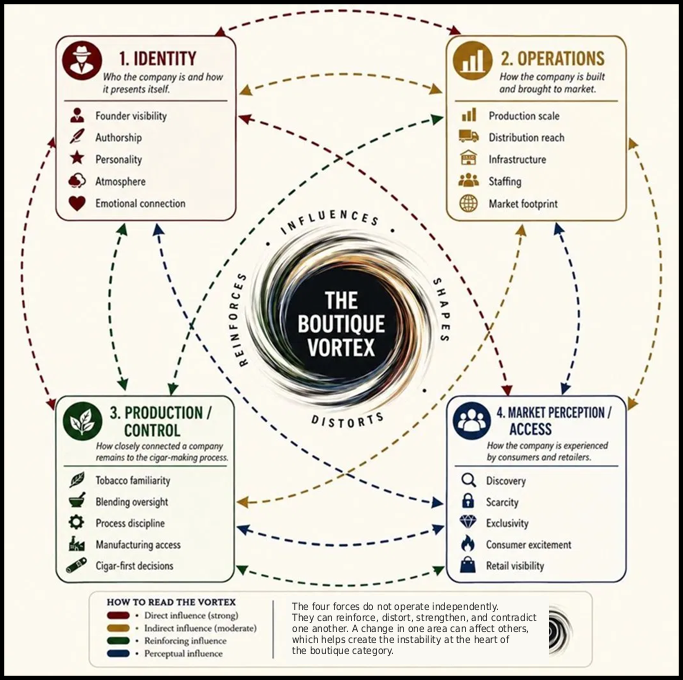
Figure 1. Boutique Interaction Map
CHAPTER 51
THE BOUTIQUE PRESSURE MAP
The Pressure Map looks at the same four systems, but it changes the question.
The Interaction Map asks how the four systems can affect one another. The Pressure Map asks: what are the pressures acting on those systems actually doing to the conditions identified in the definition?
Pressure is not the same thing as outcome.
Growth can create pressure without destroying operating discretion. Outside ownership can create substantial pressure on authority without proving that authority disappeared. Broader distribution can change access and market perception without eliminating specialization. Greater infrastructure can create institutional demands while also giving a company more ability to protect tobacco, consistency, aging, production discipline, and retailer support.
The same ambiguity exists in the opposite direction. Scarcity can reflect discipline, limited tobacco, or deliberate restraint; it can also reflect limited demand. Founder visibility can signal real proximity and accountability; it can also become theater. Small scale can preserve flexibility; it can also reflect inadequate infrastructure or dependence on decisions made elsewhere.
The presence of pressure therefore does not decide boutique status. What matters is what happens under that pressure and what survives after it.
Direct pressure means that a condition bears immediately on one of the four systems. Secondary influence means the pressure first changes another system and reaches the definition indirectly. Pressure can strengthen a condition, weaken it, alter its form, or leave its underlying substance largely intact.
A company can become larger while retaining meaningful authorship. It can operate within a larger ownership structure while preserving unusual decision-making discretion. It can expand distribution while remaining specialized. It can maintain close production authority while its public identity becomes far larger than its physical operation.
The reverse can happen just as easily. A company may retain the appearance of intimacy after meaningful authority has migrated elsewhere. It may remain small while exercising little control over the cigar. It may promote scarcity while producing nothing particularly specialized. It may preserve a founder-centered public identity after the operating structure has become far less dependent on that founder.
The practical question is therefore not which pressure wins, but whether, after those pressures are examined, Identity, Operations, Production and Control, and Market Perception and Access remain materially present in the sense required by the definition.
The Interaction Map shows how the systems can affect one another. The Pressure Map shows what happens to those systems when growth, ownership, production relationships, infrastructure, access, visibility, scarcity, and market expectations begin pushing on them.
Together, the two maps allow the definition to remain stable without pretending the companies being examined are.
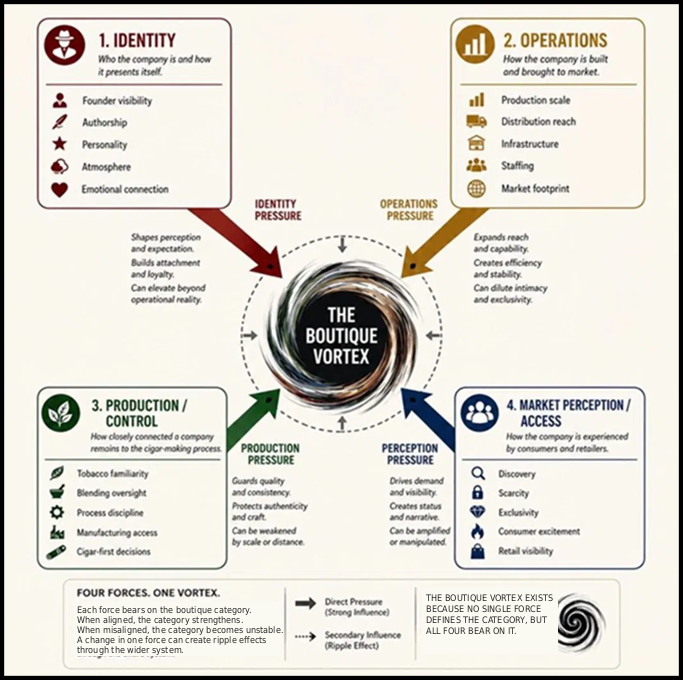
Figure 2. Boutique Pressure Map
WHERE THE VORTEX CAME FROM
The Vortex was not imposed on the manufacturer record after the fact. Its four systems and the relationships among them emerged from pressures that appeared repeatedly across the twenty questions. The terminology came later; the evidence did not.
Questions about size quickly became questions about operations. Questions about factory ownership became questions about authority. Questions about independence became questions about decision-making discretion. Questions about ubiquity became questions about access and perception. Questions about culture, founder involvement, restraint, risk, and marketing repeatedly returned to identity and the relationship between what a company was doing and what the market believed it was doing.
The Vortex organizes those recurring relationships. It does not claim that every question belongs exclusively to one system. Most of the useful evidence crossed systems, which is precisely why the Interaction Map became necessary.
The clearest points of origin are these:
| Vortex relationship | Where it emerged most clearly in the manufacturer record |
|---|---|
| Identity ↔ Operations | Q5, Q9, Q15: company maturity, ownership change, growth, and the ability of identity to survive structural change |
| Identity ↔ Production and Control | Q8, Q14, Q16: authorship, authority, creative risk, restraint, and control over consequential product decisions |
| Identity ↔ Market Perception and Access | Q3, Q5, Q15, Q17, Q18: internal versus external identity, cultural attachment, discovery, narrative, proximity, and marketing |
| Operations ↔ Production and Control | Q4, Q9, Q13: scale, infrastructure, capital, ownership context, inventory obligations, consistency, and production pressure |
| Operations ↔ Market Perception and Access | Q5, Q10, Q16, Q17: growth, distribution, visibility, ubiquity, discovery, and changing consumer proximity |
| Production and Control ↔ Market Perception and Access | Q7, Q16, Q18: specialized production, tobacco-driven limitation, restraint, scarcity, and the market value attached to perceived craft |
The same record also supplies the outward pressures represented in the Pressure Map. Identity can strengthen boutique perception while surviving changes elsewhere. Operations can create capability or institutional pressure. Production authority can protect specialization or become increasingly remote. Market perception and access can reflect genuine proximity and discovery or continue carrying an identity after the underlying conditions have changed.
Those relationships were already present before I gave them names. The Vortex simply puts them in the same room, which makes difficult companies easier to examine even when they do not become easier to classify.
CHAPTER 52
THE OUTLIERS: WHERE THE SYSTEMS STOP MOVING TOGETHER
These seven companies belong together because none fits comfortably inside a simple boutique narrative. Each brings several characteristics commonly associated with boutique into contact with characteristics that complicate that association. They are not exceptions to the analysis, and they were not selected as a validation sample for the Vortex. They are seven especially visible examples of what happens when Identity, Operations, Production and Control, and Market Perception and Access stop moving together.
These seven are illustrative, not exhaustive. Given enough scrutiny, almost any company in this record can reveal tension among scale, ownership, production authority, identity, access, and market perception. I selected these because their tensions were unusually easy to see. They are not uniquely abnormal; they simply make the classification problem more visible.
Chapter 45 makes that boundary explicit. No single characteristic automatically qualifies a company as boutique, and no single characteristic automatically eliminates it. Scale creates pressure, ownership can create pressure, and distribution, visibility, infrastructure, scarcity, founder identity, and factory relationships can all create pressure. The question is what those pressures actually do to the four conditions the definition requires.
Padrón complicates scale and history. Drew Estate complicates growth, ownership, and identity. Ferio Tego complicates the assumption that a young company must also be unknown. Graycliff complicates scarcity, prestige, and controlled access. La Flor Dominicana complicates the relationship between reputation and operating footprint. Knuckle Sandwich complicates authorship and immediate visibility. Camacho complicates the relationship between historical identity, present structure, and present authority. None can be understood through one characteristic alone, which is precisely what makes them useful.
PADRÓN: BOUTIQUE VALUES BEFORE BOUTIQUE
Padrón predates much of the modern boutique vocabulary, yet many of the qualities later attached to the term are deeply embedded in the company: family continuity, tobacco discipline, production control, identifiable leadership, and a cigar-first operating philosophy. At the same time, its maturity, distribution, recognition, and position within the premium cigar market bear little resemblance to the obscurity or limited reach often associated with the traditional boutique story.
Jorge Padrón, President of Padrón Cigars, captured one side of that tension in a published interview when he said, “This is not a numbers company. “This is a company that produces quality.” [16]
Under a simple size test, Padrón is difficult to defend as boutique. Under the definition used in this paper, size does not get to end the inquiry. Identity remains unusually coherent, Production and Control remain closely connected to the family and the tobacco, Operations are mature and substantial, and Market Perception and Access reflect a company with enormous recognition and a secure place near the center of the premium cigar industry. Those facts do not cancel one another: they create the case.
Padrón therefore asks whether operational maturity and market stature necessarily weaken boutique characteristics when identifiable authorship, production authority, specialization, and cigar-first discipline remain strongly present. It also creates a historical question underneath the structural one: did boutique create these values, or did the modern cigar market eventually attach the boutique label to values Padrón had already practiced for decades? Padrón does not need to be forced toward or away from boutique by scale alone. The more useful question is what its scale actually changed.
DREW ESTATE: WHEN IDENTITY SURVIVES STRUCTURAL CHANGE
Drew Estate creates a different tension. It began with outsider energy, founder identity, cultural disruption, unusual products, and a willingness to challenge assumptions about what a premium cigar company was supposed to look like. The company that emerged from those beginnings eventually became one of the most visible and operationally substantial organizations in the premium cigar industry.
Jonathan Drew does not describe boutique through one threshold. He identifies "production volume, distribution breadth, and brand identity" as three components of the category and adds that "the triangle can shift based on the priorities of the brand lifecycle and company values."
That shifting triangle describes the problem well. Production expanded, distribution broadened, infrastructure became institutional, and ownership changed. Identity did not move at exactly the same speed. Elements of outsider culture, founder personality, creative risk, and market perception remained attached to Drew Estate long after the company's operating structure became far more developed.
The revised definition prevents any one of those facts from deciding the case automatically. Large scale does not settle it, outside ownership does not settle it, and founder identity does not settle it either. The harder inquiry is what remains materially present now. How much operating discretion survives inside the larger structure? Where does meaningful production authority reside? How much of the market-facing identity corresponds to present operating reality, and how much reflects cultural memory built during an earlier stage of the company?
Drew Estate therefore demonstrates why identity and structure have to be measured separately. A company can retain an extraordinarily powerful identity after its operating context changes. Whether that identity is still accompanied by the other conditions required by the definition is a separate question.
FERIO TEGO: WHEN CREDIBILITY ARRIVES BEFORE HISTORY
Ferio Tego challenges the traditional assumption that boutique discovery begins with anonymity. Structurally, it entered the market as a young founder-led company. Its founders, however, did not enter as unknown people learning the business in public. They arrived with industry experience, retailer relationships, professional reputations, media familiarity, and an audience that already knew who they were.
Michael Herklots described that mismatch directly, explaining that Ferio Tego was "in some cases viewed through a more established lens… despite operating with the realities and constraints of a small, founder-led company."
The important separation is between Operations and Market Perception and Access. The company could possess the operating realities of an emerging business while entering the market with recognition normally accumulated over years.
That does not make the company less authentic; it means obscurity and youth are not the same measurement. Ferio Tego therefore asks whether discovery is actually a necessary boutique condition or merely part of the mythology surrounding how boutique companies traditionally enter the market. The people can be known before the company is. Reputation can arrive before operating history. The market no longer requires every emerging company to begin invisible.
GRAYCLIFF: BOUTIQUE THROUGH PLACE, PRESTIGE, AND CONTROLLED ACCESS
Graycliff followed a developmental path that never fit neatly inside the usual outsider narrative. Its identity grew through the Bahamas, hospitality, luxury, place, history, and controlled access. Its limited footprint is not easily explained as the temporary condition of a young company still trying to obtain distribution.
Paolo Garzaroli describes the company in terms broader than production or retailer count, calling Graycliff "a curated experience, not just a product."
That description moves the analysis directly into Identity and Market Perception and Access. Graycliff was never built only around boxes occupying humidor space. Place, hospitality, memory, exclusivity, and controlled access became part of the experience surrounding the cigar. Its proximity to consumers developed through destination and experience rather than through the familiar sequence of small production, gradual retailer discovery, founder visibility, and later expansion.
That creates a different problem. Selectivity can be imposed by limited capital, lack of distribution, weak demand, or insufficient production. It can also be deliberate. Those are not the same operating facts even if the resulting cigar is equally difficult to find. Graycliff therefore tests whether controlled access can remain a meaningful boutique characteristic when it is an intentional part of the operating model rather than an obstacle the company has not yet overcome. Scarcity tells us that access is limited; it does not tell us why.
LA FLOR DOMINICANA: WHEN REPUTATION EXCEEDS FOOTPRINT
La Flor Dominicana exposes the difference between how large a company is and how large it feels. The company is vertically integrated, established, highly respected, widely recognized, and culturally prominent. Its founders and cigars occupy considerably more space in the premium cigar conversation than a simple production number would suggest. That visibility can make LFD appear structurally larger than it actually is.
Litto Gomez identified the imbalance himself when he observed that "our brand always had a bigger name than the actual size of our company."
That sentence is almost a direct description of separation between Operations and Market Perception and Access. Reputation and operating footprint are not the same measurement. Awards, retailer awareness, consumer loyalty, founder recognition, and decades of accumulated reputation can create a market presence far larger than annual production, staffing, infrastructure, or physical footprint would suggest. Under the revised definition, that reputation is neither a qualification nor a disqualification. The question is whether the market's perception corresponds to the underlying Identity, Operations, and Production and Control that remain present.
LFD therefore demonstrates how success itself can distort classification. A company can appear ubiquitous because nearly everyone in the premium cigar industry knows it without occupying the same operating scale as the industry's largest manufacturers. Recognition is real; scale is real: they simply are not the same fact.
KNUCKLE SANDWICH: WHEN VISIBILITY ARRIVES BEFORE DISCOVERY
Knuckle Sandwich reverses another traditional sequence. It did not spend years moving from obscurity to discovery to broader recognition. Guy Fieri, Co-Founder of Knuckle Sandwich Cigars, brought enormous public visibility into an existing partnership with Espinosa, allowing recognition to arrive almost immediately.
That creates an obvious reason for scrutiny. Celebrity visibility can produce attention without proving authorship, production authority, specialization, or meaningful involvement. Fieri confronted precisely that suspicion in the published record when he rejected the idea that the project should become “a brand-stamped celebrity thing.” [18]
But the reverse assumption is no safer. Immediate visibility does not prove superficiality any more than obscurity proves authenticity. The relevant questions belong to the other systems. Is there identifiable authorship and purpose behind the project? Who exercises meaningful authority over development and production? Is the cigar genuinely specialized, or is the identity doing all the work? Does the market-facing story correspond to the actual relationship among the people responsible for the product?
Knuckle Sandwich therefore demonstrates why Market Perception and Access cannot stand in for Identity or Production and Control. Visibility can arrive first. The rest still has to be examined.
It also reinforces why the unit of classification matters. A celebrity-associated cigar, the brand carrying it, Espinosa as the operating partner, and Espinosa Cigars as a company are not automatically the same analytical unit.
CAMACHO: WHEN IDENTITY SURVIVES OWNERSHIP CHANGE
Camacho presents perhaps the clearest separation between historical Identity and present Operations. Its historical identity remains strongly connected to Honduras, Corojo tobacco, the Eiroa family, and the operating culture under which the brand established itself. Its present institutional setting is very different: Camacho now operates inside the much larger Davidoff organization.
Law Ream challenges the idea that operational maturity should automatically end the boutique discussion, arguing that "if ‘boutique’ demands small scale imperfection, then the term becomes self-defeating."
That objection is even more useful under the revised definition. Improved infrastructure, greater consistency, deeper resources, or institutional maturity do not automatically eliminate boutique characteristics, nor does outside ownership settle the classification by itself.
But ownership still matters because it can change the conditions underneath the identity. The relevant questions are no longer simply who owns Camacho or whether consumers still associate the brand with its history. The questions are what present ownership has done to operating discretion, where meaningful production authority now resides, how closely the current product remains connected to the identity consumers recognize, and whether the market-facing Camacho corresponds to the company and cigar that exist today. Historical identity did not disappear on the date ownership changed, but that does not mean the rest of the system remained unchanged either.
Camacho therefore illustrates one of the Vortex's most important ideas: the four systems can move on different schedules. Ownership can change in a day; identity usually does not.
WHAT THE OUTLIERS ESTABLISH
The outliers do not produce seven verdicts: that would defeat the reason they are here. They demonstrate what happens when the four systems separate. Padrón combines mature operations and enormous market stature with family continuity, production authority, and tobacco discipline. Drew Estate combines institutional development and changed ownership with an identity whose cultural force survived those changes. Ferio Tego entered with startup operations but established market credibility. Graycliff reached historical maturity while preserving deliberate selectivity and a highly specific experience. La Flor Dominicana developed a market reputation larger than its apparent operating footprint. Knuckle Sandwich entered with immediate visibility before the ordinary process of discovery could occur. Camacho carries a powerful historical identity inside a very different present institutional structure.
These are not seven versions of the same problem. They show why no single proxy deserves veto power. Size informs Operations; ownership informs operating context; factory relationships inform Production and Control; founder visibility informs Identity; scarcity and distribution inform Market Perception and Access. None tells us everything.
The revised definition requires all four areas to be examined. These seven cases are useful because their separations are unusually visible, not because they are the only companies in which they occur or because they validate the Vortex. The model came from pressures already present throughout the manufacturer record; these cases make them easier to see.
The purpose is not to eliminate disagreement or produce binary scores: it is to make the source of disagreement visible.
THE LINE THE DEFINITION DRAWS
Refusing to issue seven verdicts does not mean the definition is incapable of excluding anything. It means difficult cases should not be forced into certainty the evidence cannot support. An analytical standard still has to be able to reject the easy claim.
A small company does not become boutique merely by purchasing limited production, attaching a founder-centered story, and restricting distribution. If the cigar was selected from production substantially designed by somebody else, consequential blend and tobacco decisions reside elsewhere, the company lacks meaningful authority to reject or delay production, and scarcity is being asked to substitute for authorship, the company may be small and the cigar may be difficult to obtain. Those facts do not satisfy the definition.
The same discipline works in the other direction. A large or mature company does not automatically disqualify every specialized cigar it produces if identifiable authorship, operating discretion, production authority, accountability, and genuine market distinction remain present in that particular production. The unit still has to be named, the evidence still has to be examined, and the four conditions still have to be materially present. Otherwise the Vortex is not a definition. It is hospitality.