1. Baseball, Memory, and Me
Begins with baseball as family history: the game passed from father to son, the players who stayed in memory, and the arguments that eventually became this book.
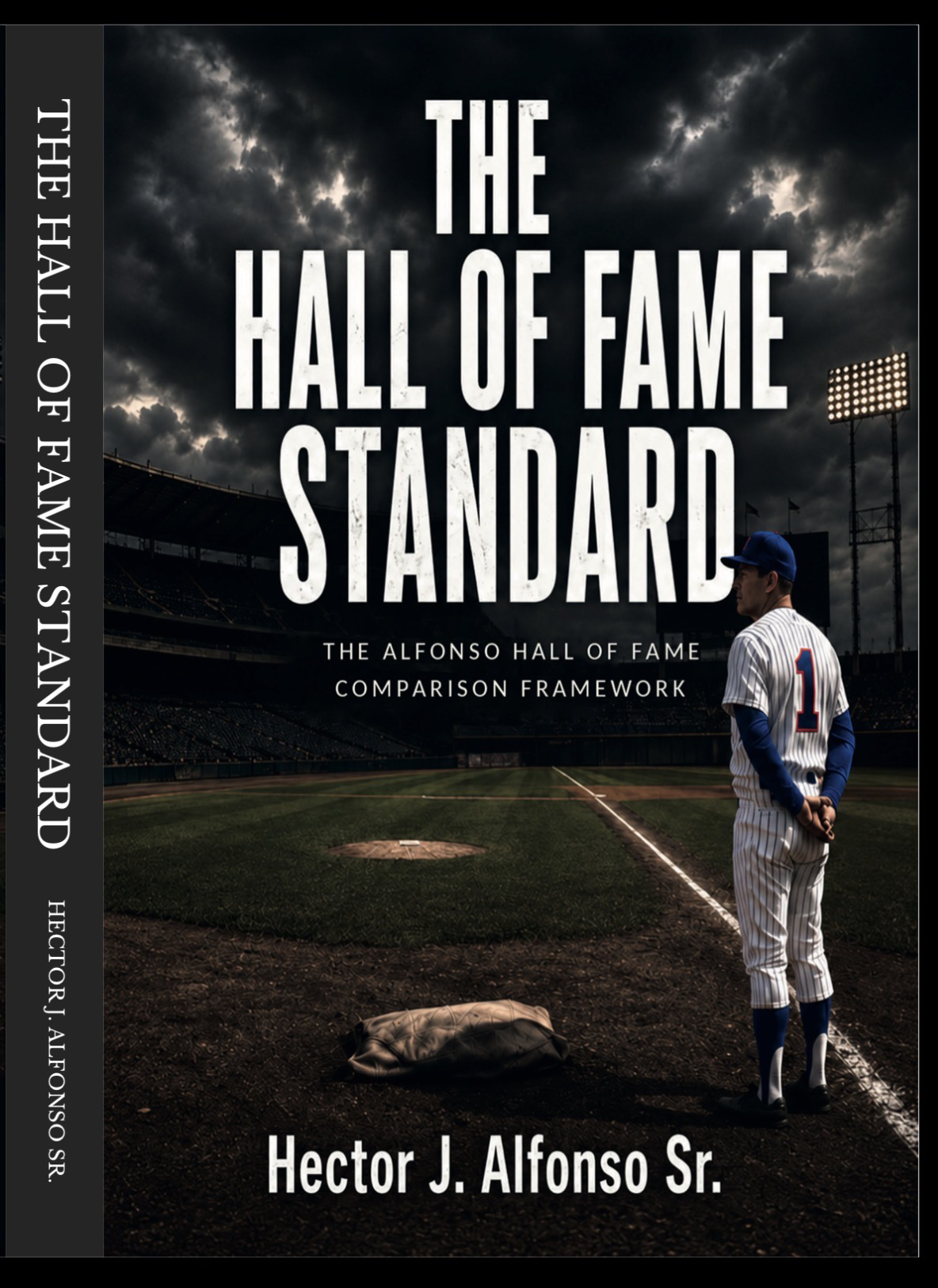
Book Overview
Measuring Players Against Hall of Fame Precedent
Introducing ECHO and the Alfonso Hall of Fame Comparison Framework (AHCF)
Baseball has argued about the Hall of Fame for generations. The problem is not a shortage of opinions. It is that the standard often seems to change depending on the player being discussed.
The Hall of Fame Standard approaches the problem from a different direction. Instead of inventing a new cutoff for greatness, it uses Cooperstown’s own elected members as precedent and asks whether the same standards can be applied consistently to players still standing outside.
The Alfonso Hall of Fame Comparison Framework begins with Baseball-Reference WAR, then places that value into historical context through ECHO. It considers the complete career, the strongest consecutive seven-year period, the job the player actually performed, workload, and the competitive conditions of the era. It does not project missing seasons or guarantee a favorable answer.
The point is not to end baseball arguments. That would be unnatural and possibly illegal. The point is to make the argument answer to the precedent Cooperstown already created.
Join the preorder notification list and be notified when ordering opens. The first 50 copies will be signed.
Join the Preorder Notification ListThe descriptions below identify what each chapter is testing without giving away every player result before the book reaches its findings.
Begins with baseball as family history: the game passed from father to son, the players who stayed in memory, and the arguments that eventually became this book.
Asks why Hall of Fame arguments seem to change their standard from player to player, and whether the same rules can be applied consistently.
Establishes the central premise that the Hall’s elected members are the precedent against which later candidates should be measured.
Separates statistical benchmarks, historical precedent, positional roles, and the institutional choices already made by Cooperstown.
Explains why complete-career value and sustained peak value are separate but related paths within the comparison framework.
Shows why players should be compared to the work actually performed, rather than forced into one universal statistical threshold.
Rejects artificial fragmentation of left, center, and right field when careers routinely move across all three positions.
Defines the treatment of players whose careers genuinely cross positional categories without awarding bonus credit simply for versatility.
Separates starting pitchers and relief pitchers because workload, role, and elected precedent are fundamentally different.
Uses published Baseball-Reference WAR as the common statistical foundation rather than creating a proprietary replacement for the underlying value measure.
Explains why the competitive environment surrounding a season must be considered before value from different periods is treated as directly interchangeable.
Introduces the Era-Context Hall Output model and the logic used to place seasonal WAR into historical competitive context.
Defines the governing continuous seven-year peak window and explains why sustained excellence matters more than cherry-picking isolated seasons.
Uses the strongest five-year stretch as supporting evidence without allowing it to replace the governing seven-year peak test.
Examines how value is distributed across a career and distinguishes sustained production from highly concentrated bursts.
Introduces the descriptive comparison measure used to show where a candidate sits relative to elected precedent.
Sets out the rules that keep small statistical differences from being treated as categorical truths when the evidence is effectively equivalent.
Tests catchers against the elected precedent created by the Hall, where workload and positional demands materially shape career totals.
Examines the standard for a position traditionally expected to produce substantial offensive value.
Tests a historically uneven Hall record and the careers that sit near or beyond the elected second-base precedent.
Examines one of Cooperstown’s most revealing positional inconsistencies and the candidates affected by it.
Compares candidates against a position whose offensive and defensive expectations have changed substantially across baseball history.
Applies one outfield comparison population rather than pretending that career movement among the three positions creates separate species.
Tests players whose principal value came from hitting rather than fielding against the Hall precedent already created for that role.
Compares starters while accounting for the dramatic workload differences separating pitching eras.
Treats relief pitching as its own job rather than judging relievers against workloads they were never asked to carry.
Applies the framework to genuine cross-role careers while preserving the rule that versatility itself does not earn bonus points.
Tests whether traditional milestones still function as meaningful evidence once career context and era are considered.
Examines MVPs, Cy Young Awards, All-Star selections, and similar honors as evidence rather than automatic Hall credentials.
Considers defensive value and the problem of treating offensive production as though it were the only baseball work that matters.
Tests what repeated defensive recognition adds to the Hall argument and where it does not overcome a larger value deficit.
Separates meaningful October performance from the temptation to let a few memorable games rewrite an entire career.
Tests the recurring tendency to turn team success into individual Hall evidence.
Distinguishes genuine accumulated value from simply remaining employed for a long time.
Examines the other side of the argument: whether brilliance compressed into fewer years can still satisfy established Hall precedent.
Tests how reputation, memory, media framing, and the stories attached to careers can influence Hall judgment beyond the underlying record.
Treats vote totals as evidence that must be read in the context of ballot congestion, eligibility rules, and the competition surrounding each election.
Examines the Hall’s character language and the instability that follows when voters apply it selectively.
Addresses PED-era candidates, institutional complicity, selective punishment, and the problem created when moral certainty outruns consistent evidence.
Uses a familiar fraud analogy to examine what happens when the system itself benefits from behavior it later claims to have discovered with horror.
Defines the 100-player study population and explains why the group was selected to test the Hall’s existing precedent.
Begins with candidates whose statistical placement leaves comparatively little doubt under the framework.
Examines careers clustered around governing thresholds where context, role, and the guardrails matter most.
Tests candidates whose public reputation is so strong that the argument often begins with the conclusion.
Returns attention to careers that compare strongly with elected precedent but receive far less Hall discussion.
Tests a position where elected precedent and public perception often diverge sharply.
Examines candidates whose all-around value is often obscured by the offensive expectations applied to other positions.
Tests the tension between offensive reputation, defensive contribution, and the elected standard at a traditionally bat-heavy position.
Examines candidates whose raw career totals can look modest until the demands of the position are taken seriously.
Tests modern starters without requiring them to reproduce innings totals from baseball environments that no longer exist.
Separates actual relief value from the temptation to let one familiar counting statistic define the entire role.
Tests offensive specialists against the Hall precedent created by players whose principal job was to hit.
Shows where forcing a cross-role career into one position can distort the comparison and why hybrid treatment must remain disciplined.
Rejects the idea that the Hall has a fixed capacity and argues that the real question is whether a player reached a form of greatness Cooperstown has already recognized.
Finally reveals the classifications withheld during the player chapters and explains the meaning of Both, Career, Peak, Neither, and Historical Value.
Identifies the players who reached both the governing complete-career precedent and the separate consecutive seven-year Peak standard.
Identifies the players whose complete careers reached elected precedent even though their strongest seven-year periods did not reach the separate Peak standard.
Identifies the players whose strongest sustained seven-year periods reached elected precedent even though their complete careers fell short of the Career standard.
Applies a separate historical designation for players who materially changed or illuminated baseball without turning historical importance into a fifth statistical pathway.
Identifies the candidates who did not reach either governing playing-value standard, including several careers that conventional Hall discussion often treats very differently.
Reviews the results that most sharply challenged the author’s prior baseball memory and forced a second look at the calculations.
Confronts the cases where the framework produced answers the author personally disliked, which is precisely why a consistent method matters.
Explains what it means when a candidate reaches an elected playing-value precedent without pretending the framework itself can award Hall membership.
Places candidates visually among elected players so readers can see who actually occupies the statistical neighborhood around a career.
Draws the positional lessons from the study and shows which baseball jobs Cooperstown has recognized more cleanly than others.
Pulls together the institutional evidence from ballots, committees, positions, character debates, and elected precedent.
Returns to the assumptions that began the project and identifies what survived, what changed, and what the evidence forced the author to abandon.
Answers the title question: the Hall standard is not one milestone or one WAR cutoff, but the body of precedent Cooperstown created through actual elections.
Ends where the book began, with baseball memory, family, the players time threatens to erase, and the reason the calculations mattered in the first place.
Presents the governing sequence and the complete 100-player results table in one place.
Documents the positional baselines, role rules, hybrid treatment, and workload logic used by the framework.
Sets out the mathematics behind complete-career ECHO and the use of published Baseball-Reference season WAR.
Documents the governing consecutive seven-year Peak test and the supporting five-year windows.
Explains HCF and the descriptive measures used to show where a career’s value was concentrated.
Records the elected comparison population and the precedents used to establish governing standards.
Explains how candidate careers are located among elected players performing comparable baseball work.
Documents the historical-environment model and how season difficulty becomes season-level ECHO.
Collects the audit trail, sensitivity checks, reproducibility notes, limitations, and source controls.
Provides the complete leaderboard for the candidate and elected-comparator population.
Preorders begin October 19, 2026. Available November 2. Join the notification list now and I will let you know when ordering opens. The first 50 copies will be signed.
Join the Preorder Notification List