1. Baseball, Memory, and Me
Begins with baseball as family history: the game passed from father to son, the players who stayed in memory, and the arguments that eventually became this book.
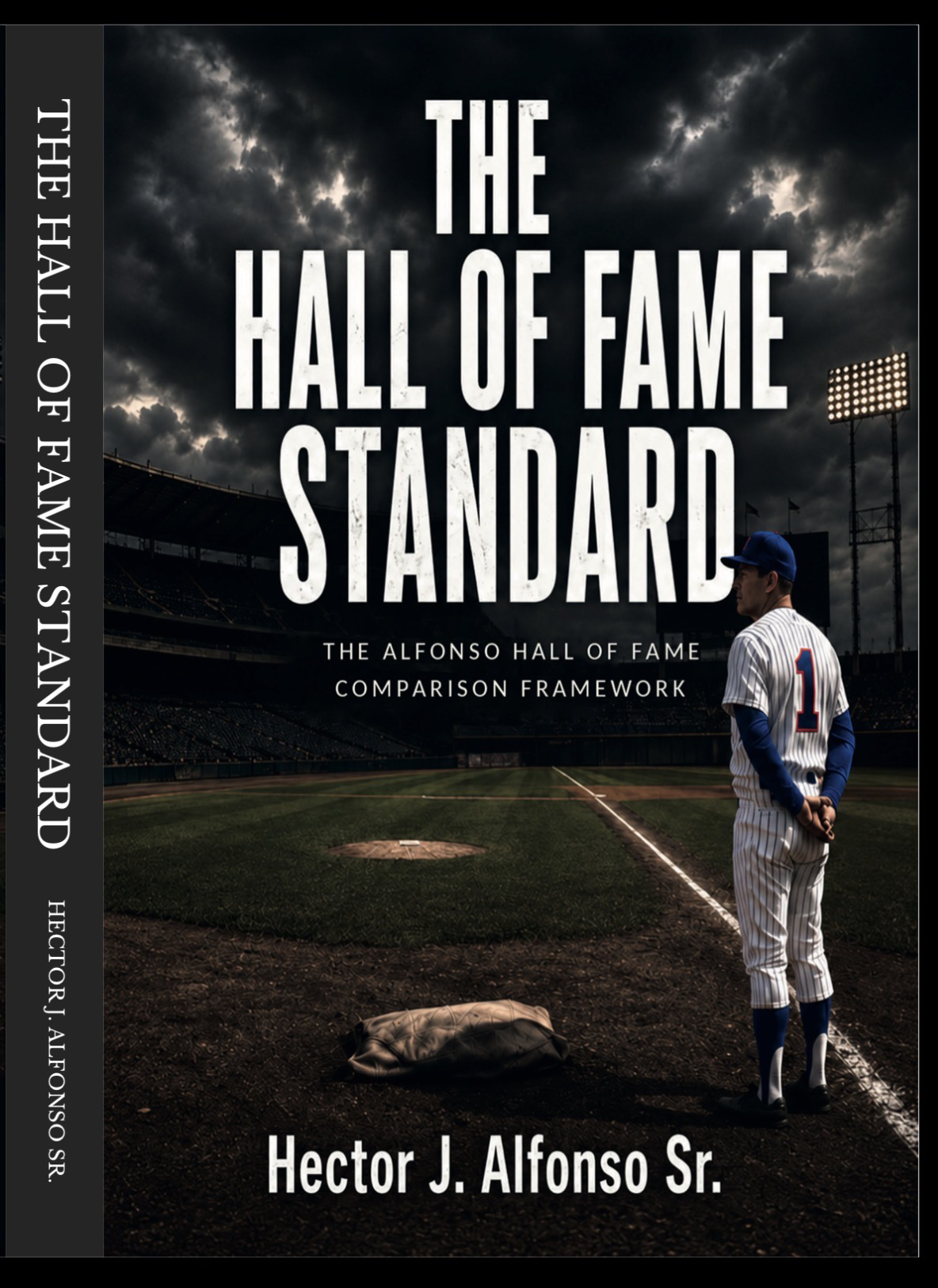
Book Overview
Measuring Players Against Hall of Fame Precedent
Introducing ECHO and the Alfonso Hall of Fame Comparison Framework (AHCF)
Baseball has argued about the Hall of Fame for generations. The problem is not a shortage of opinions. It is that the standard often seems to change depending on the player being discussed.
The Hall of Fame Standard approaches the problem from a different direction. Instead of inventing a new cutoff for greatness, it uses Cooperstown’s own elected members as precedent and asks whether the same standards can be applied consistently to players still standing outside.
The Alfonso Hall of Fame Comparison Framework begins with Baseball-Reference WAR, then places that value into historical context through ECHO. It considers the complete career, the strongest consecutive seven-year period, the job the player actually performed, workload, and the competitive conditions of the era. It does not project missing seasons or guarantee a favorable answer.
The point is not to end baseball arguments. That would be unnatural and possibly illegal. The point is to make the argument answer to the precedent Cooperstown already created.
The descriptions below identify what each chapter is testing without giving away every player result before the book reaches its findings.
Begins with baseball as family history: the game passed from father to son, the players who stayed in memory, and the arguments that eventually became this book.
Asks why Hall of Fame arguments seem to change their standard from player to player, and whether the same rules can be applied consistently.
Separates questions that Hall debates routinely mix together: value, role, workload, era, career shape, and elected precedent.
Looks at the many different kinds of careers Cooperstown has already elected and treats that variety as evidence of the Hall’s actual standard.
Sets the guardrail for historical comparison: context can be reconsidered, but careers cannot be completed with seasons a player never actually had.
Explains why Baseball-Reference WAR provides the common value foundation while refusing to treat one statistic as the entire Hall of Fame argument.
Distinguishes value from workload and asks how to compare players whose positions and roles demanded very different amounts and kinds of work.
Separates competitive difficulty from playing conditions so older and modern eras can be compared without pretending either had every advantage.
Introduces the Single-Season Environmental Difficulty Index, which combines competitive and playing-condition histories into a season-by-season measure.
Shows how the environmental index becomes a usable season adjustment and how ECHO places a player’s WAR into historical context.
Defines the two governing playing-value tests: the complete career and the player’s strongest consecutive seven-year period, with five years retained as supporting evidence.
Rejects an invented universal cutoff and instead uses players Cooperstown actually elected as the governing precedent for comparison.
Explains how the framework handles careers that crossed genuinely different roles without pretending one positional label describes the whole player.
Defines the limits of the framework and keeps awards, reputation, historical importance, character, and other human judgments from being smuggled into the math.
Examines the first-base candidates against elected precedent, where offensive production carries much of the position’s traditional burden.
Evaluates careers at a position where defense, durability, on-base value, and all-around contribution can be easier to overlook than headline offensive totals.
Tests a position that has often been asked to satisfy both corner-infield offense and demanding defensive expectations without one clean Hall standard.
Compares shortstops whose Hall cases were built from very different mixtures of defense, speed, durability, and offense.
Presents the catcher candidates and their playing records before the book later turns to Cooperstown’s larger problem with valuing the position.
Looks beyond the loudest batting statistics to careers built through combinations of offense, walks, baserunning, throwing, defense, and sustained value.
Measures candidates at a position where a handful of all-time giants can make excellent careers look smaller than they actually were.
Examines the designated-hitter role and the candidates whose careers crossed between DH and substantial defensive work elsewhere.
Tests the book’s largest and most varied group while accounting for a job whose workload and usage changed dramatically across generations.
Compares relievers across an evolving role that moved from multi-inning firemen to modern one-inning closers.
Handles players whose careers genuinely crossed positions or roles while preserving one career, one value record, and no bonus for versatility.
Examines why offensive value is easier to preserve in baseball memory and why defense can disappear from Hall discussions even when it materially shaped a career.
Treats Gold Gloves as useful evidence of defensive reputation and recognition without pretending the award is a complete measurement of defensive value.
Returns to the institutional problem at third base, where Cooperstown has never supplied one obvious model for what an elected career should look like.
Asks why baseball gives catchers extraordinary responsibility while Hall evaluation often reduces them to offensive totals that ignore much of the job.
Reconstructs the older relief role in which the best bullpen arm entered when the game was in danger, not simply when the ninth inning began.
Challenges the habit of discounting players for succeeding in a role Major League Baseball deliberately created and teams deliberately asked them to perform.
Uses Phillips to show the difference between a reserve who fills holes and an everyday player whose value came from legitimately working across the field.
Resists the temptation to complete an injury-shortened career with imagined healthy seasons and evaluates only the baseball that actually happened.
Places Coors Field inside the much longer history of ballparks that shape offense and asks why one park became a uniquely powerful Hall of Fame stigma.
Looks at careers shortened by injury, physical decline, or tragedy while keeping sympathy separate from invented production.
Makes room for historical importance without converting courage, influence, or significance into imaginary statistical value.
Examines how famous moments and narratives can grow so large that they distort or replace the career that produced them.
Looks at strong careers that faded from public memory because of market, teammates, timing, geography, or the absence of one defining image.
Explains the 100-player study boundary and acknowledges worthy careers that could not be added without turning the candidate pool into a census.
Explores how postseason opportunity shapes memory without treating October exposure as proof of regular-season greatness.
Revisits Tiant’s case through the playing record, Hall precedent, and a personal connection that makes the institutional rejection difficult to dismiss casually.
Separates Pete Rose’s extraordinary playing career from the gambling case, punishment, and the Hall’s long refusal to place him on the ballot.
Turns the investigation from candidates to the institution and asks what Cooperstown’s own elections reveal about the standards it has actually accepted.
Examines managerial election without inventing a formula and compares the inconsistent ways Cooperstown has treated successful managers.
Shows that inconsistency is not a modern analytics problem; it has been present in Hall voting from the institution’s earliest elections.
Explains how ballot congestion, eligibility rules, and the surrounding candidate pool can change a player’s voting fate even though his career never changes.
Argues for voter accountability and transparency without requiring voters to reach any particular baseball conclusion.
Clarifies what it means to finish near or above an elected precedent and why comparison to one Hall member is evidence, not an automatic chain reaction of elections.
Tracks how the same completed career can be judged by changing electorates, procedures, and institutional incentives over time.
Shows that careers crossing roles are not a theoretical problem invented by the framework; Cooperstown has already elected players with similarly mixed careers.
Examines the PED problem and the precedent that will be created when the Hall eventually elects a player with an unmistakable performance-enhancing-drug history.
Explores how the Hall’s definition of greatness has shifted as the game, statistics, voters, committees, and public attitudes changed.
Uses Curt Schilling and other cases to examine how character judgments enter Hall voting and how inconsistently that standard has been applied.
Rejects the idea that the Hall has a fixed capacity and argues that the real question is whether a player reached a form of greatness Cooperstown has already recognized.
Finally reveals the classifications withheld during the player chapters and explains the meaning of Both, Career, Peak, Neither, and Historical Value.
Identifies the players who reached both the governing complete-career precedent and the separate consecutive seven-year Peak standard.
Identifies the players whose complete careers reached elected precedent even though their strongest seven-year periods did not reach the separate Peak standard.
Identifies the players whose strongest sustained seven-year periods reached elected precedent even though their complete careers fell short of the Career standard.
Applies a separate historical designation for players who materially changed or illuminated baseball without turning historical importance into a fifth statistical pathway.
Identifies the candidates who did not reach either governing playing-value standard, including several careers that conventional Hall discussion often treats very differently.
Reviews the results that most sharply challenged the author’s prior baseball memory and forced a second look at the calculations.
Confronts the cases where the framework produced answers the author personally disliked, which is precisely why a consistent method matters.
Explains what it means when a candidate reaches an elected playing-value precedent without pretending the framework itself can award Hall membership.
Places candidates visually among elected players so readers can see who actually occupies the statistical neighborhood around a career.
Draws the positional lessons from the study and shows which baseball jobs Cooperstown has recognized more cleanly than others.
Pulls together the institutional evidence from ballots, committees, positions, character debates, and elected precedent.
Returns to the assumptions that began the project and identifies what survived, what changed, and what the evidence forced the author to abandon.
Answers the title question: the Hall standard is not one milestone or one WAR cutoff, but the body of precedent Cooperstown created through actual elections.
Ends where the book began, with baseball memory, family, the players time threatens to erase, and the reason the calculations mattered in the first place.
Presents the governing sequence and the complete 100-player results table in one place.
Documents the positional baselines, role rules, hybrid treatment, and workload logic used by the framework.
Sets out the mathematics behind complete-career ECHO and the use of published Baseball-Reference season WAR.
Documents the governing consecutive seven-year Peak test and the supporting five-year windows.
Explains HCF and the descriptive measures used to show where a career’s value was concentrated.
Records the elected comparison population and the precedents used to establish governing standards.
Explains how candidate careers are located among elected players performing comparable baseball work.
Documents the historical-environment model and how season difficulty becomes season-level ECHO.
Collects the audit trail, sensitivity checks, reproducibility notes, limitations, and source controls.
Provides the complete leaderboard for the candidate and elected-comparator population.