Introduction
Why a confrontation that repeatedly failed to achieve its stated objectives survived for nearly seven decades, and why the usual one-sided explanations are not enough.
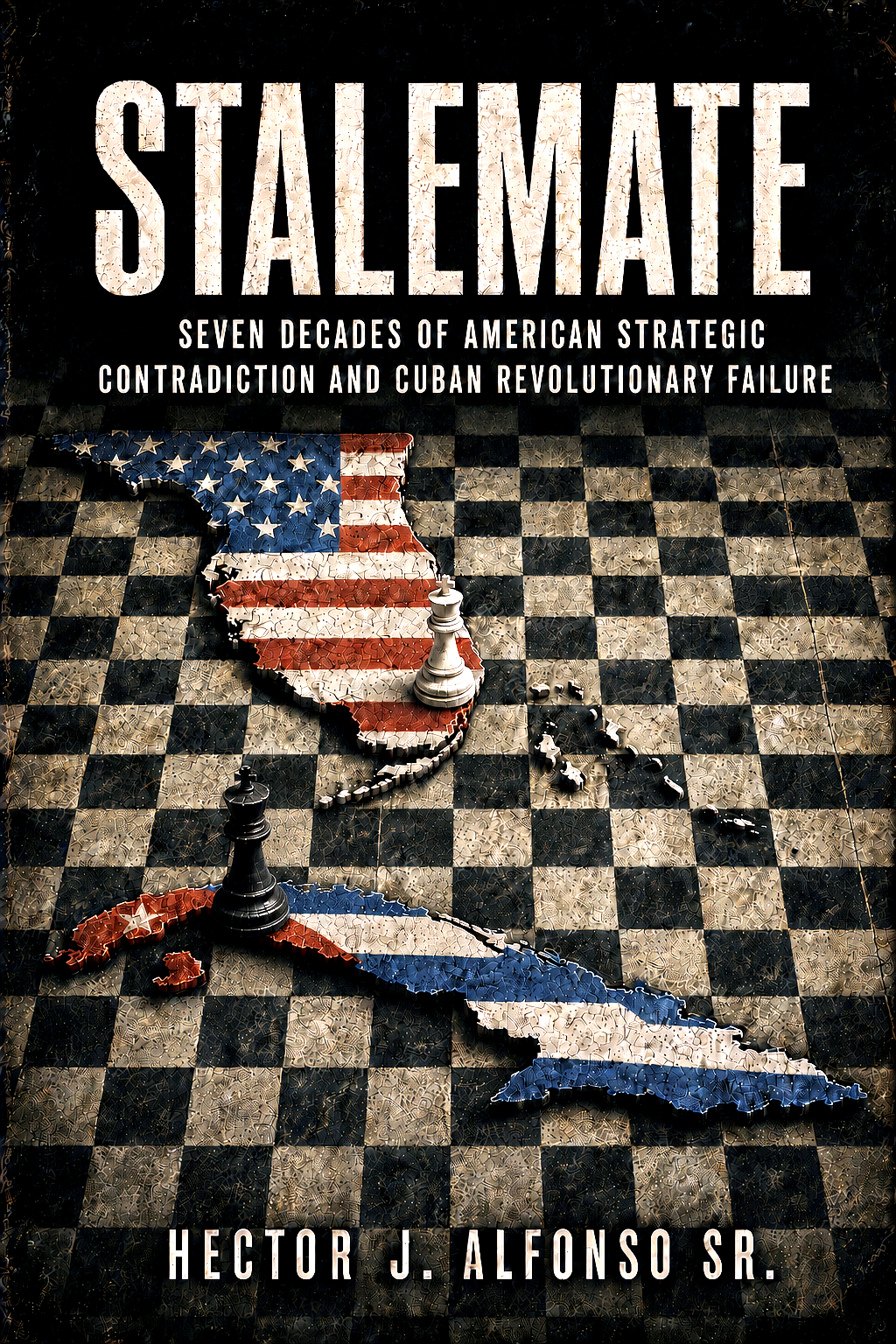
Book Overview
Seven Decades of American Strategic Dysfunction and Cuban Revolutionary Failure
For nearly seven decades, Washington and Havana have told themselves different versions of the same comforting story: the other side is the reason the conflict never ended.
Stalemate tests both stories against the record. It follows the relationship from Cuban independence and Batista through the Revolution, the Bay of Pigs, the Missile Crisis, covert war, Soviet dependence, exile militancy, migration, propaganda, intelligence operations, sanctions, economic collapse, and the survival of the revolutionary system after Fidel Castro.
The book does not argue that Washington and Havana failed in the same way. They did not. Washington spent decades pursuing political outcomes it could not produce. Havana preserved political power while failing to deliver many of the economic, political, and civic promises made in the name of the Revolution. Both governments learned how to survive the conflict. Neither learned how to end it.
The result was not victory. It was stalemate.
The descriptions below identify the question or problem each chapter takes on. They are summaries, not substitutes for the argument.
Why a confrontation that repeatedly failed to achieve its stated objectives survived for nearly seven decades, and why the usual one-sided explanations are not enough.
The author’s personal connection to the history and why disclosing that perspective is more honest than pretending to approach Cuba without one.
Family, exile, memory, and the assumptions one generation passes to the next before the evidence gets a chance to interfere.
The evidentiary rules of the book: what is documented, what is allegation, what is inference, what is disputed, and where the record simply does not permit certainty.
The roots of the relationship: Cuban independence, American intervention, the Platt Amendment, and the unequal balance of power built into the republic from the beginning.
Batista’s path from army sergeant to political power, his elected presidency, his return through the 1952 coup, and the dictatorship that followed.
What the United States actually supported, tolerated, opposed, and misunderstood about Batista, without reducing the relationship to the familiar claim that he was simply Washington’s puppet.
The anti-Batista struggle before Fidel Castro became its dominant symbol, including the broader political forces that helped create the revolutionary moment.
The enormous legitimacy the Revolution possessed in 1959 and the harder question that followed: what, exactly, had the Cuban people authorized its leaders to build?
The trials and executions of Batista-era officials, the public demand for punishment, and the early collision between revolutionary justice, due process, and political power.
How a broad anti-Batista coalition narrowed as competing visions of the Revolution were pushed aside and Fidel Castro increasingly became its political owner.
The period before the relationship hardened, when American officials were still trying to determine who Castro was, what he intended, and where the Revolution was going.
The evidence behind competing claims about Castro’s ideology and the point at which conviction, strategy, Soviet alignment, and political necessity began to merge.
The revolutionaries who opposed Batista but resisted the Revolution’s communist direction, and what their removal reveals about how the governing coalition narrowed.
Agrarian reform, nationalization, American property claims, compensation disputes, and the economic confrontation that accelerated the break between Washington and Havana.
How Cuba and the Soviet Union moved toward one another, and why the familiar claim that Washington alone drove Castro into Moscow’s arms is too convenient.
How political language helped define the Revolution, its enemies, and its relationship with the United States, while turning terms such as imperialism, internationalism, embargo, and blockade into competing descriptions of the same conflict.
The American shift from diplomatic and economic pressure to the conclusion that Castro’s government should be removed.
The intelligence judgments behind covert action and the belief that internal opposition could be converted into a broader political collapse.
How the covert program became an invasion plan, how Brigade 2506 was organized, and how operational assumptions shaped what landed at the Bay of Pigs.
The choices President Kennedy inherited, changed, approved, and restricted, and why responsibility for the final operation cannot be assigned to the CIA alone.
Castro’s declaration of the socialist character of the Revolution in April 1961 and the political and military circumstances surrounding it.
The anti-Castro insurgency in central Cuba, the people who fought it, Havana’s response, and the way the Bay of Pigs changed the meaning of internal resistance.
The covert campaign that followed the Bay of Pigs: sabotage, infiltration, destabilization, psychological warfare, and another American effort to make the regime break.
What is documented, what became legend, and how assassination planning became part of the machinery of American covert action against Cuba.
The extraordinary proposals considered by the Joint Chiefs for creating or exploiting incidents that could justify direct American military action against Cuba.
Cuba’s fear of invasion, Soviet nuclear strategy, American power, and the decisions that brought the world closer to nuclear war than either side had intended.
What the missile settlement revealed about Cuban sovereignty when Moscow protected Cuba, armed Cuba, and then negotiated over Cuba without Fidel at the table.
The congressional and political framework that made military force against Cuba an explicit American option during the confrontation.
Cuba’s intervention beyond its borders and the effort to turn revolutionary success on one island into a model for political warfare elsewhere.
How fear of another Cuba reshaped American policy across Latin America through reform programs, counterinsurgency, covert action, and direct intervention.
Che’s attempt to export guerrilla revolution and the failures that exposed the limits of treating the Cuban experience as a transferable formula.
The central contradiction of revolutionary Cuba: economic and military dependence on the Soviet Union alongside real evidence of independent Cuban action.
Cuba’s intervention in Angola, the debate over Soviet control, and how the war helped kill a tentative opening between Washington and Havana.
The broader American record in the hemisphere and why acknowledging that history does not require pretending Havana had no agency of its own.
Cuba’s effort to lead the non-aligned world while remaining deeply tied to one of the two superpowers.
The political system built around Fidel Castro: nationalist, Marxist-Leninist, anti-American, internationalist, pragmatic when necessary, and intensely personal.
The UMAP labor camps and the Revolution’s attempt to define not only acceptable politics but the kind of Cuban the new society intended to produce.
The failed 1970 harvest as a test of revolutionary will, mass mobilization, economic reality, and Fidel Castro’s governing instincts.
How economic failure pushed Cuba more deeply into the Soviet system and made dependence part of the price of revolutionary survival.
The transformation of revolutionary power into constitutional structure and the formal institutionalization of one-party rule.
The gap between the Revolution’s egalitarian claims and the privileges available to senior leaders and politically protected institutions.
Cuba’s doctrine for making invasion prohibitively expensive through national mobilization, dispersed resistance, and the promise of a long occupation war.
Fidel’s rejection of parts of Soviet-style economic management and his effort to restore ideological discipline and revolutionary mobilization.
A direct assessment of the Revolution against the promises and standards it set for itself, not the ones imposed by its enemies.
Why Cuba can be a genuine victim of American power without turning that victimhood into a permanent exemption from responsibility for its own choices.
Why political exile and ordinary migration are not the same thing, even when later generations and later migration waves make the boundary less comfortable.
The first large post-revolutionary migration arrangements and the emergence of migration as both a human consequence and a political instrument.
The changing American relationship with Cuban exiles, including the world of covert operations, intelligence contacts, and the distrust that followed when policy changed.
The armed exile struggle, covert operations, sabotage, terrorism, infiltration, and the line between attacking a regime and attacking civilians.
The late-1970s opening between Havana and members of the exile community as family separation began breaking through the hardest political prohibitions.
The 1980 boatlift as migration crisis, political confrontation, social shock, and one of the events that permanently changed both Cuba and Miami.
The Reagan administration’s attempt to raise the regional cost of Cuban and Soviet influence without turning the confrontation into a direct invasion of Cuba.
The long fight over information, from revolutionary broadcasting to Radio Martí, and the competing efforts to shape what Cubans and Americans believed about the conflict.
Cuba’s relationships with sympathetic journalists, intellectuals, activists, and political figures in the United States, while keeping influence, sympathy, and espionage analytically separate.
Cuban intelligence operations against the United States and exile community, including penetration, recruitment, deception, and the long contest below the level of open war.
How post-Soviet economic collapse produced another mass exodus and forced Washington and Havana into a new migration arrangement.
The evolution of Brothers to the Rescue from humanitarian search-and-rescue missions in the Florida Straits to increasingly confrontational anti-Castro activity.
The 1996 shootdown, the political consequences in Washington, and the conditions that helped turn Helms-Burton into law.
How money from exiles became economically important to a government that had spent decades treating much of the exile community as an enemy.
The culture of improvisation, barter, personal connections, leakage, and theft that grew around chronic shortages and state control.
Fraud, benefits, remittances, travel, and criminal schemes that complicate the political mythology surrounding exile, migration, and the island.
How Cuban exile politics changed across generations, migration waves, class divisions, ideology, and a relationship with Cuba that never stopped evolving.
The prosecution and execution of General Arnaldo Ochoa and what the case revealed about power, loyalty, discipline, and accountability inside the revolutionary system.
Cuba’s post-Soviet economic catastrophe and the political adaptations that allowed the government to survive conditions many observers assumed would destroy it.
Why the moment of maximum Cuban economic vulnerability did not produce the political collapse American policy had spent decades anticipating.
How Venezuelan oil, financing, and political partnership bought Havana time without truly recreating the Soviet relationship.
The military institutions and enterprises that became increasingly central to Cuba’s economy and to Raúl Castro’s model of governance.
How both governments prepared for a post-Fidel era, and why Havana proved better at separating leadership succession from regime succession.
The decision to test engagement after concluding that decades of isolation had failed to produce the political result Washington said it wanted.
The dismantling of much of Obama’s policy and the return of pressure without a simple restoration of the old pre-Obama system.
A new Cuban leader inherits both the institutions of the Revolution and an American adversary already built into the political logic of the system.
How mass emigration can relieve pressure on an authoritarian system by making departure more attainable than sustained political organization against the state.
The American indictment connected to the 1996 Brothers to the Rescue shootdown, treated as a significant legal development without confusing allegation with verdict.
Why infrastructure, production, and daily life can deteriorate badly while the institutions required to preserve political control remain intact.
How sanctions, statutes, waivers, executive actions, and repeated policy swings produced a Cuba policy that became easier to reverse than to explain strategically.
The people and institutions beyond Fidel Castro that helped the revolutionary state survive leadership change and preserve its governing machinery.
Why revolutionary Cuba survived Fidel Castro himself and why institutions of control ultimately mattered more than the biography of one man.
The strongest evidence-based case against American conduct toward Cuba, presented without turning American wrongdoing into a universal explanation for Cuban failure.
The strongest case against the revolutionary government, while separating legitimate American grievances from Washington’s own strategic failures and excesses.
The final accounting: what Washington achieved, what Havana preserved, what each side failed to accomplish, and why endurance was not the same thing as victory.
The question beyond stalemate: what Cuba might learn from other political and economic transitions when the system that survived for decades can no longer continue in the same form.
The chapter guide reflects the current manuscript structure: 77 chapters across eleven parts, followed by the author’s postscript, When Tomorrow Comes.