PART I
THE TERM AND ITS INSTABILITY
CHAPTER 1
BACKGROUND
Like many useful conversations in this business, this one started over coffee before the trade show. What begins as "How's the show so far?" or "Did you try anything special?" sometimes turns into something more valuable.
The question did not fully land until the second day, when someone media-adjacent casually said, "Look at all the boutiques in the front row." That was the moment the term split.
"Boutique" entered the premium cigar conversation as shorthand for a specific kind of company. It suggested smaller production, limited distribution, founder proximity, direct involvement, and a position slightly outside the established system. It carried more than size. It carried identity.
Like Bohemians, Beatniks, punks, and other groups that needed language to separate themselves from the mainstream, the term gave those companies a place to stand. It told the market they were not legacy houses, not institutional brands, and not trying to be either. The distinction felt relatively clear: companies operating with fewer layers, closer authorship, narrower reach, and a different relationship to the consumer than the established houses surrounding them.
That earlier clarity is what made the trade-show comment so useful. If "boutique" could now describe companies occupying some of the most visible and commercially established positions in the room, then the issue was no longer whether the term had history. The issue was whether its earlier boundaries still matched the market still using it.
CHAPTER 2
COMPETING INTERPRETATIONS
One of the first problems in this paper was that "boutique" rarely entered the conversation with a stable meaning attached. People used the term confidently. They simply did not use it consistently.
For some contributors, boutique still referred primarily to scale: smaller production, narrower distribution, tighter operational footprints, emerging-company status. For others, it had shifted toward identity, founder visibility, authorship, personality, accessibility, and the perception that a company still felt direct or personally driven regardless of how large it became. Others tied boutique more closely to process, autonomy, positioning, or consumer perception. Those interpretations were not random. They reflected different ways of measuring the same category. That became the first major point of instability: the industry was not simply disagreeing over one definition. It was applying different measurement systems while continuing to use one term.
CHAPTER 3
WHY THE TERM NEVER STABILIZED
Twenty-five years of public attempts to define boutique produced production caps, ownership tests, identity arguments, quality assumptions, and no lasting consensus. Cigar media, retailers, trade organizations, and industry writers repeatedly tried to organize the category through formal or semi-formal definitions, but the results never fully converged.
As early as 1999, SMOKE Magazine cited a working definition describing boutique companies as manufacturers producing fewer than 1.5 million cigars annually. That threshold was later referenced in Halfwheel's 2013 editorial Boutiques, which also noted that the term was already unclear and being used in multiple ways [1].
By 2012, Cigar Coop observed that the definition could be sliced and diced many different ways and that there was simply not a precise definition [2].
In 2015, the host of The Cigar Authority asked, "What Exactly Is a Boutique Cigar?" and reached a similar conclusion: some defined it through production under one million cigars, others through limited quantity, smaller factories, or independent ownership, but no single standard held consistently [3].
Halfwheel later reported that the Boutique Cigar Association attempted to formalize the category by defining boutique companies as those producing fewer than 500,000 cigars annually [4]. The association gave boutique one of its clearest institutional tests, but that production-cap model never became the settled organizing standard for the broader market. The association later ended its non-profit status and moved toward a social community platform [5].
Elsewhere, definitions expanded rather than narrowed. Tobacco Business reported that boutique could refer to production numbers, distribution size, or portfolio scope, while retailer interviews widened the category further to include small upstart companies, independent ownership, small-batch intent, passion-driven production, and distinctive identity [6]. Stogie Press approached the term through owner involvement across the entire process, from tobacco selection through marketing, while other sources shifted emphasis toward construction quality, tobacco selection, craftsmanship, and small-batch experimentation [7][8].
The contradictions continued across the broader market. Cigars.com alternately described boutique through production thresholds, quality focus, and the acknowledgment that the category has no set definition [9]. Cigar Dojo tied the concept to smaller independent companies producing limited-run cigars while acknowledging that scale and independence were related, but not identical, ideas [10].
Direct contradictions eventually appeared within the same publication. Tobacco Business presented competing interpretations in separate interviews: Claudio Sgroi framed boutique through manufacturing precision and consistency, while Skip Martin, Co-Founder of RoMa Craft Tobac, rejected the term altogether as an outdated distinction no longer reflecting modern production realities [11]. Earlier cultural coverage complicated the issue further: Tobacco Business and Cigar Press both treated boutique partly as a generational and cultural movement tied to outsider founders, nontraditional brand identity, and companies that could grow far beyond their original scale while retaining an alternative identity [12][14].
Cigar Inspector described boutique cigars as limited production, independently owned cigar companies, while also framing the category through singular authorship: cigars made in the image of a singular person, with a singular point of view [13]. Cigar Aficionado used the word differently in its 1997 interview with Ernesto Pérez-Carrillo, Founder of Casa Carrillo, contrasting his Miami operation, described as almost a boutique operation, with the commercial-scale Dominican factory created during La Gloria Cubana’s expansion [15]. Even within published sources, boutique could mean ownership and authorship in one context and operating scale in another.
Depending on the source, boutique could describe production volume, distribution reach, company size, ownership structure, process discipline, product philosophy, scarcity, founder involvement, market positioning, consumer perception, or identity itself. The definitions did not converge over time; they accumulated. That instability matters because the term kept performing real market work the entire time. Boutique still shaped consumer expectation, retailer positioning, media framing, and growth narratives even when the conditions underneath the label varied substantially.
THE BOUTIQUE CIGAR ASSOCIATION
The Boutique Cigar Association matters here because it represents one of the clearest formal attempts to organize the category around a measurable production threshold. By limiting membership through annual production volume, it gave boutique an institutional framework rather than leaving it entirely to market habit, media language, or consumer interpretation. That effort remains historically important even though the broader market never settled around its production cap.
The association’s formal dissolution in late 2025 should not be overstated as proof that this framework failed. Public explanations for the closure pointed toward the limitations of a volunteer board and individual business pressures, with leadership ultimately urging members to unite behind larger national trade associations [5][19]. The safer conclusion is that the BCA’s production-cap model never became the settled organizing standard for the broader premium cigar market.
CHAPTER 4
WHAT COUNTS AS EVIDENCE
This paper also encountered a considerable amount of retailer-driven, affiliate-driven, influencer-adjacent, and sales-oriented material discussing boutique cigars through promotional language, discovery framing, bundle marketing, and "best boutique cigars" lists.
Those sources reflected legitimate consumer-facing use of the term, but they served a different purpose. Much of that material used boutique as retail shorthand signaling curiosity, selectivity, exclusivity, scarcity, or discovery. That works in a humidor, a buying guide, or a promotional post. It becomes less useful once the objective shifts from product discovery to determining whether the category still separates operating realities with meaningful consistency. This paper does not present a formal consumer survey. Consumer behavior is examined through retailer observations, media ecosystems, community visibility, event culture, release pursuit, social participation, and observable market behavior. The analysis is therefore behavioral and comparative rather than quantitative.
The same caution applied to forum discussions and fragmented social media debates. Those spaces can produce useful observations, but the signal-to-noise ratio deteriorates quickly, and definitions often become circular, individualized, emotionally defended, and increasingly detached from measurable business distinctions.
CHAPTER 5
A NOTE ON CUBAN CIGARS
While reviewing the early definitions, I was asked a reasonable question: “Cuban cigars are scarce, difficult to obtain, and encountered in limited quantities, particularly by American consumers. Why would they not be considered boutique?”
The question is useful because it shows how easily one attractive characteristic can take over the entire category. Scarcity may contribute to boutique perception, but scarcity alone tells us very little about independence, authorship, production authority, specialization, or the relationship between the people responsible for the cigar and the market around it.
My answer is no. I would not classify Cuban cigars as boutique simply because access to them may be restricted or quantities may appear limited. Scarcity created by law, geography, allocation, distribution, or political circumstance is different from scarcity created through deliberate production restraint, tobacco availability, specialization, or principal-directed control. A cigar can be difficult to obtain without being boutique. Rarity describes availability. It does not explain authorship, production authority, operating structure, or who controls the decisions behind the cigar. And, of course, the commercial importation of Cuban cigars into the United States remains generally prohibited. That does not move them closer to boutique. It moves them closer to contraband. [17]
Scarcity is only part of the reason Cuban cigars enter this paper. It is impossible to talk about scarcity, exclusivity, and prestige without addressing how the Cuban market practically invented the modern playbook for manufactured market pressure.
One reason Cuban cigars belong in this narrow discussion is that Habanos S.A. has long used structured scarcity as part of its premium-market architecture. Its Ediciones Limitadas have been produced since 2000 in small quantities and unusual formats, while Regional Editions are deliberately restricted to particular territories and presented in numbered boxes. [20] Those programs predate much of today’s limited-drop culture and show how scarcity, geography, packaging, and prestige can be engineered together.
The lesson is not that every limited Habanos release is cynical marketing. Some scarcity reflects tobacco, aging, or genuine production limits. The narrower point is that scarcity can be created by release design as well as by operational constraint. Once a large organization can produce exclusivity through format, geography, and allocation, rarity stops being reliable evidence of boutique structure. Modern boutique companies did not invent the psychology of limited access, and the Cuban programs show why scarcity cannot carry the classification by itself.
These examples provide a useful reminder that one recognizable characteristic cannot be allowed to carry an entire classification. Scarcity can create exclusivity. Exclusivity can create prestige. Prestige can create cultural weight. None of those conditions, by itself, establishes boutique.
The same problem appears throughout this paper. Smallness can be mistaken for craftsmanship. Independence can be mistaken for quality. Founder visibility can be mistaken for authority. Limited production can be mistaken for intention. Any one of those characteristics may contribute to the boutique association, but none should be allowed to do the work of all the others.
Rarity is not classification.
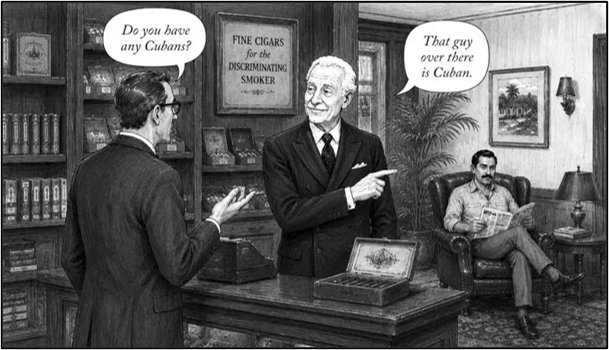
Cuban cigars therefore remain outside the classification developed here. I am not going to force individual Cuban brands, factories, or cigars into boutique or non-boutique categories. That resolves the classification question. It does not end Cuba’s relevance to the discussion. Its scarcity, prestige, quality, distribution, and possible reentry into the American market test several assumptions attached to the word.
THE CUBAN EXCEPTION
As a rule, I do not seek out Cuban cigars. That decision is personal. It comes from respect for what my parents suffered while leaving the island after a revolution whose promises proved duplicitous. Call that political, emotional, or even hypocritical if you wish. It is still my position.
I have nevertheless been handed Cuban cigars by people in the industry and expected to light one in a shared moment. Refusing would have turned the cigar into a political statement of its own. So I partook. If it was bad, as too many of them have been, I found myself hoping somebody would knock it from my hand and bring the proceedings to a merciful end.
When a Cuban cigar is good, it can be very good. When it is poorly made, plugged, tunneling, canoeing, or otherwise unwilling to cooperate, it can be remarkably bad. The only silver lining is that there is often very little gray area.
The experience can resemble standing at a craps table. Come on, seven. Instead, snake eyes. The cigar tunnels, the draw closes, the burn heads for another zip code, and the pass line is finished. Then, every once in a while, the dice cooperate and something superior appears. It does not happen often enough for me to make seeking them out worthwhile.
I have said before that Cuban-cigar smokers may be the great masochists of the premium-cigar world. Habanos S.A. can sell someone a box, congratulate him on a magnificent purchase, and then explain that the cigars may be ready in five or ten years. Boutique companies, independents, legacy manufacturers, and platform brands do not have that luxury. We cannot ask the consumer’s humidor to become our final production department.
As a cigar maker, I believe Cuban cigars are a shadow of what they were twenty-five years ago and, too often, a memory of what they once represented. That is my opinion, informed by the cigars I have smoked and the production standards by which I judge my own work. It is not offered as a statistical finding, and nobody is required to share it.
If the American market ever reopened fully to Cuban cigars, they would not suddenly become boutique. Their established brands, centralized production system, global distribution structure, and institutional history would remain what they were the day before the law changed. Cuba would also face a harder practical question: whether present tobacco supply, consistency, construction, and quality-control capacity could satisfy the demand created by legal American access. Restricted supply may create urgency. It does not create boutique authorship.
ANALYST NOTE
When precision carries legal or regulatory consequences, the industry does not rely on the word “boutique.” Regulatory advocacy has centered instead on “premium cigar,” a category that can be tied to observable product characteristics such as handmade construction, whole-leaf tobacco, long filler, and traditional production methods. Boutique may carry considerable cultural and commercial meaning, but it depends too heavily on interpreted characteristics such as identity, independence, ownership, scale, market position, proximity, and perception to perform the same job. The industry may understand what boutique is trying to communicate without being able to make the word precise enough to carry legal responsibility.