PART II
THE MARKET CHANGED
CHAPTER 6
THE TRADE SHOW TEST
The trade show provides one of the clearest views of how the category changed because it shows how the market behaves, not merely how it describes itself. Booth location, retailer traffic, media attention, portfolio depth, consumer visibility, and sustained presence all reveal something about where a company sits in the industry.
Booth placement is not proof of boutique status or its opposite. Prominent space can reflect payment, seniority, relationship history, logistics, or simple longevity. It becomes useful only when read beside the rest of the evidence. When the same companies also command retailer traffic, recurring launch attention, broad distribution, established event schedules, and predictable consumer interest, the old outsider picture becomes harder to maintain.
Many companies once discussed primarily as boutique brands now operate as established participants with measurable influence. Retailers monitor their launches. Media outlets track their releases. Consumers anticipate their products. Competitors watch their decisions. Genuinely smaller operations still exist under much narrower conditions, with tighter distribution, smaller production cycles, greater founder dependence, and considerably more exposure to inventory and financial risk.
The trade show does not settle the definition. It establishes the first market contradiction: companies can retain boutique identity long after they stop behaving like fringe participants.
CHAPTER 7
RANKINGS AND CONSENSUS
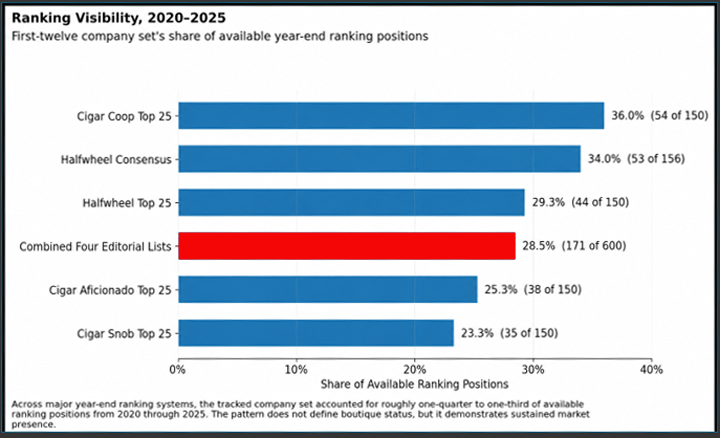
Year-end cigar rankings provide another way to examine how the market changed. They do not determine whether a company is boutique, and they are not being used here as measures of quality. They are useful because repeated appearances across major ranking systems reveal something narrower and more relevant to this study: sustained visibility.
For this comparison, I tracked the companies associated with the first twelve manufacturers who began the study: Black Label Trading Company / Black Works Studio, Room101, Drew Estate, Espinosa Cigars, Viaje, Illusione, Crowned Heads, Tatuaje, RoMa Craft Tobac, Foundation Cigar Company, Casa Carrillo, and Dunbarton Tobacco & Trust. Where appropriate, closely associated product lines or collaborations were included with the company responsible for them. The purpose was not to argue that these companies occupy identical positions in the market. They clearly do not. The purpose was to see how frequently a group strongly associated with the modern boutique and independent cigar movement continued appearing in major public recognition systems.
The period examined was 2020 through 2025. For consistency, only the first twenty-five cigars from each annual editorial ranking were counted. That created 150 available positions in each six-year editorial series. Halfwheel’s annual Consensus ranking was also examined separately because it aggregates selections from multiple cigar publications and media outlets rather than representing a single editorial staff.
Across those systems, the pattern was difficult to describe as fringe participation.
THE COMPARISON GROUP CHECK
When the broader comparison group is added, the pattern becomes stronger. The combined field accounted for 89 of 150 Cigar Coop positions, approximately 59.3 percent; roughly 63 of 150 Halfwheel Top 25 positions, about 42 percent; and 69 of 150 Cigar Snob positions, approximately 46 percent. Cigar Aficionado remained narrower at 38 of 150, while the Halfwheel Consensus produced 53 of 156. Across the five systems, the companies examined in this paper accounted for approximately 312 of 756 available placements, roughly 41.3 percent.
That does not create a boutique ranking. It demonstrates that much of the population still discussed through boutique, independent, founder-driven, post-boutique, platform, or legacy language now competes inside the center of premium cigar recognition rather than outside it.
ANALYST NOTE
Rankings and aggregate recognition systems are not neutral instruments. Coverage creates familiarity, familiarity creates review opportunity, and repeated coverage can feed year-end lists and consensus systems. The rankings here measure recurring visibility across multiple recognition environments. They do not measure organic consensus by themselves.
CHAPTER 8
FROM THE FRINGE TO THE CENTER
Boutique once carried a strong implication of discovery. The company was smaller, less familiar, harder to find, or operating outside the established center of the business. That condition still exists, but it no longer describes every company carrying the label.
Trade-show presence, rankings, retailer familiarity, recurring launches, broad distribution, media coverage, and consumer expectation accumulate. Over time they create market gravity. A company can remain independent, founder-driven, highly personal, and creatively distinctive while also becoming a normal part of the industry’s center.
Moving toward the center does not mean becoming corporate, losing craft, or making worse cigars. It means the old equation between boutique and fringe position can no longer be assumed. Market location changed even when identity did not.
CHAPTER 9
THE NEW CIGAR COMMUNITY
The modern cigar community developed inside an unusual communication environment. Tobacco companies face advertising restrictions, reduced platform visibility, inconsistent moderation, and limited access to ordinary digital promotion. The industry adapted by building decentralized networks around lounges, events, podcasts, livestreams, retailer media, social groups, factory visits, and direct interaction.
Cigar Dojo is useful as one example because it behaves less like a conventional review publication than a virtual cigar lounge. Consumers post what they are smoking, follow releases, discuss products in real time, join live programming, and interact with other smokers and industry personalities. That activity measures something different from a ranking: recurring engagement, familiarity, founder recognition, release anticipation, and cultural durability.
Retailer podcasts and lounge-driven media expanded the same ecosystem. They project the personality of the store and its community far beyond the physical humidor. Manufacturers, retailers, reviewers, podcasters, and consumers now reinforce visibility simultaneously. That creates a market in which participation can produce recognition before a customer ever sees the box on a shelf.
CHAPTER 10
THE HUMIDOR CHANGED TOO
The evolution is also visible inside the humidor. Earlier boutique brands often depended on scarcity, selective placement, word of mouth, and the pleasure of finding something unfamiliar. Many operated with narrow distribution, inconsistent retailer access, limited production depth, and uncertain shelf presence.
Portions of that population matured. Companies still associated with boutique identity now maintain recurring national retail presence, dedicated humidor space, sustained event schedules, retailer partnerships, repeat release cycles, branded merchandise, and reliable consumer recognition across multiple markets.
Humidor presence is not merely logistical. It reflects retailer confidence, inventory commitment, consumer demand, reorder behavior, relationship depth, and the expectation that the cigar will move. Once a company becomes deeply embedded in that environment, the old distinction between discovery brand and established brand becomes harder to sustain, even when consumers still experience the company as personal or boutique.
Being easier to find did not necessarily make the relationship less personal. The more important change was what happened after the cigar left the humidor. Purchase increasingly became only the beginning of the consumer’s relationship with the company.
CHAPTER 11
FROM PURCHASE TO PARTICIPATION
Premium cigar consumption is no longer limited to purchasing, smoking, and developing preferences. For many consumers, the activity expands into lounges, events, social communities, podcasts, livestreams, release tracking, branded merchandise, factory visits, retailer culture, and direct interaction with the people behind the product.
That changes the relationship between scale and intimacy. Broader distribution or greater visibility does not necessarily weaken attachment. In some cases, it gives consumers more ways to participate, and the relationship becomes stronger as the company grows.
The consumer can therefore remain emotionally close to a company whose operating structure has become much more developed. That gap between operational distance and emotional distance is one of the reasons boutique identity can survive structural change.
That progression is not exclusive to boutique. Legacy companies and platform brands can create the same kind of attachment, and many do. The reason it belongs in this paper is that the path from recognition to participation has often been more important to boutique and emerging brands because they begin without inherited shelf position, broad advertising reach, or automatic consumer familiarity. For them, participation is not merely something that happens after recognition. It is often one of the ways recognition is built, and sometimes where the relationship begins to change.
CHAPTER 12
THE CUSTOMER ATTACHMENT AND ROLE-CONVERSION PATHWAY
One recurring pattern among companies identified as boutique is the strength of the attachment they can develop among consumers and, somewhat more cautiously, retailers. It seems especially pronounced when a smaller or emerging company is competing against brands that already possess history, distribution, shelf space, and broad recognition. Established and legacy brands unquestionably have loyal supporters, stalwarts, and even fanatics. I would argue, however, that supporters of smaller brands are often more vocal and resolute because their loyalty includes a connection through discovery. They did not simply select an established cigar already familiar to the market. They found something, watched it develop, introduced it to other smokers, and sometimes recommended it to retailers that did not yet carry it. They engage in full-throated defenses of the brand, its principles, its people, and its products. Put more plainly, they do not play any shit when it comes to something they believe they helped discover.
Retailers can develop a similar attachment, although they generally have to express it with greater diplomacy. A retailer may care deeply about a particular company while dealing with dozens of other brands competing for shelf space, purchasing dollars, event dates, and attention. Personal enthusiasm has to coexist with the practical obligations of operating a humidor and maintaining many industry relationships. The retail environment can also become part of the consumer’s attachment. A trusted clerk may be the person who first puts an unfamiliar cigar in a customer’s hand, while many lounges develop one or more experienced regulars whose opinions carry unusual weight in the room. I think of them as alpha smokers. They hold no title and have no formal authority, but other smokers listen to them because their judgment has earned credibility over time. A customer may initially trust the cigar because he trusts the person recommending it.
The connection created through discovery is not usually available in the same form with an older, established brand. It can remain ordinary loyalty, but it can also grow into participation, advocacy, industry immersion, and eventually a different role within the trade. One of the more unusual characteristics of the premium cigar business is the degree of access consumers have to the people behind the product. In many industries, the relationship between customer and manufacturer is filtered through retail systems, customer-service departments, advertising, and several layers of corporate separation. Premium cigar consumers routinely interact with founders, owners, blenders, sales representatives, retailers, media personalities, and other company principals through events, lounges, podcasts, livestreams, factory visits, social media, private groups, and continuing community participation.
Owners and company principals can become part of those relationships themselves. Some communicate directly with consumers or participate in the same groups, and the interaction can become personal, social, professional, or occasionally business-related. They learn who people are, what they do, who their friends are, where they travel, what else they enjoy, and sometimes what is happening in their lives outside cigars. That familiarity adds another layer of connective tissue between the consumer, the company, and the community around it. The relationship is still built around a commercial product, but it no longer behaves like an anonymous commercial relationship.
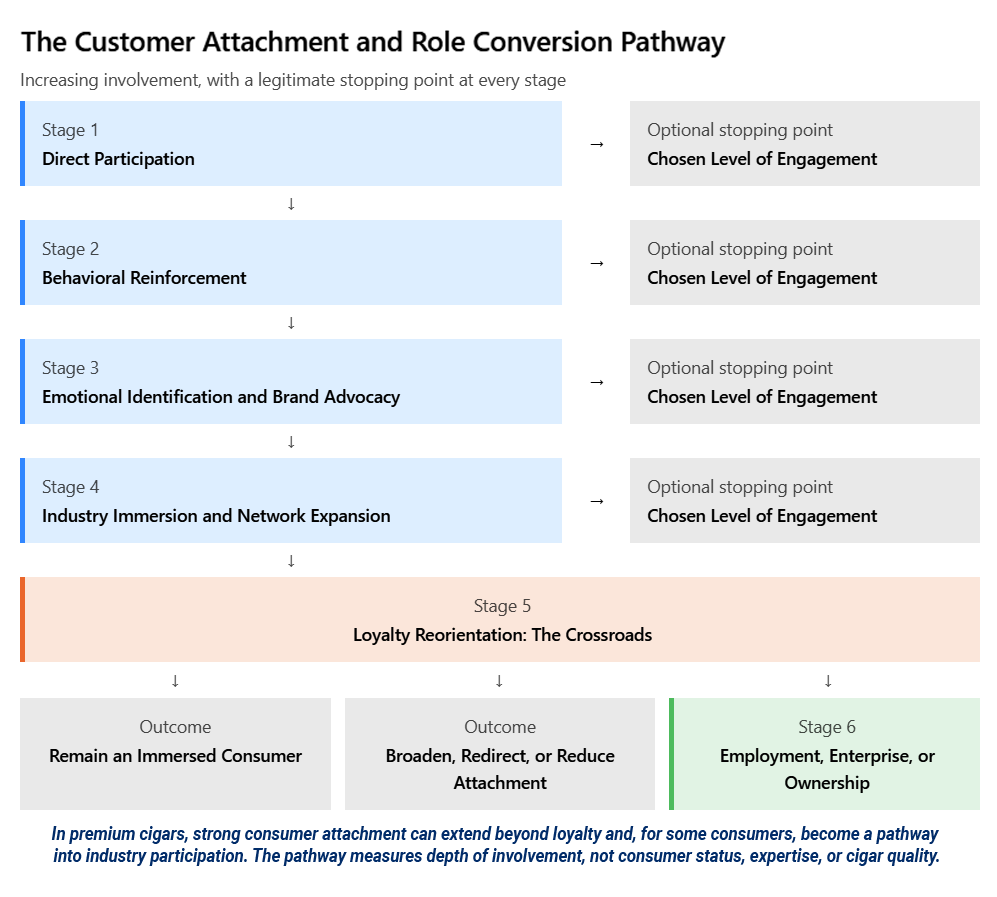
Consumers are therefore not merely purchasing cigars. They are participating in communities built around familiarity, ritual, recognition, conversation, and repeated interaction. In some cases, that participation eventually changes the consumer’s relationship not only with the original company but with the entire premium cigar industry. The pathway that follows is not a mandatory sequence or a ranking of better consumers. A person may remain at any stage indefinitely and be perfectly content there. Others may move forward, move backward, skip certain activities, or leave the pathway entirely. Remaining at a stage is not a failure to progress. A consumer who enjoys the cigars, attends events, spends time with friends, and wants nothing more from the relationship has reached exactly the place he wants to be. The pathway measures depth and direction of involvement, not product quality, expertise, consumer status, personal worth, or loyalty points.
STAGE ONE: DIRECT PARTICIPATION
The first stage represents direct participation: buying and smoking the cigars, attending events, spending time in lounges, interacting through social media, communicating with company representatives, meeting principals, and becoming a recurring presence within the brand’s community. The customer begins recognizing the people behind the cigars, and those people may begin recognizing the customer. The relationship remains centered on the product, but it is no longer entirely anonymous. Many consumers remain happily at this stage. They buy the cigars, attend events when convenient, follow the company online, and enjoy the relationships that develop around it. They have no desire to become advocates, content creators, volunteers, employees, or anything else. They are customers and supporters, and that is enough. For others, repeated participation begins affecting purchasing habits, travel, friendships, and personal routines.
STAGE TWO: BEHAVIORAL REINFORCEMENT
Behavioral reinforcement begins when the consumer follows release schedules, seeks particular allocations, travels to events, buys merchandise, joins groups, and organizes portions of his cigar purchasing around the company and its community rather than around isolated products. The cigar still has to perform. Familiarity, trust, anticipation, and participation have simply become part of the purchasing decision. Consumers at this stage begin learning the company’s history, its portfolio, its principals, and the stories behind individual releases. They listen when company representatives appear on podcasts and cigar shows, follow interviews and livestreams, join official and unofficial groups, and share information about where particular cigars can be found. They are no longer familiar only with the cigars they smoke. They understand how those cigars fit within the company and the people responsible for making and selling them.
The groups formed around a company can become remarkably close. Members may spend months communicating through Facebook, Instagram, email, private chats, and Zoom before meeting in person. Eventually, they arrange to meet at cigar events, lounges, factory trips, larger nationally known gatherings such as Big Smoke or the Rocky Mountain Cigar Festival, or gatherings of their own. Some travel together for weekends, visit distilleries, follow whiskey or bourbon trails, and build friendships around interests that eventually have very little to do with the company that originally brought them together. Members also trade cigars and send one another unexpected packages, sometimes containing rare or difficult-to-find releases, a practice commonly called “bombing.” The exchange is part generosity, part sport, and part evidence that the relationship has moved beyond people merely buying the same product.
Many of those friendships eventually extend beyond, and sometimes surpass, the original brand connection. The company may have provided the introduction, but the bond belongs to the people. A consumer can remain at this stage for years, following the company, buying its releases, participating in the groups, and enjoying the friendships without carrying the brand’s identity outward. For others, repeated participation and personal connection develop into something stronger.
STAGE THREE: EMOTIONAL IDENTIFICATION AND BRAND ADVOCACY
At the third stage, the relationship begins functioning less like ordinary product loyalty and more like cultural attachment. Consumers identify with the company, its people, its philosophy, its presentation, or the community formed around it. Supporting the company becomes connected to supporting something they believe reflects their own taste and judgment. Many of these consumers become brand advocates. Brand advocate is not an industry title, a paid position, or a contractual designation. It describes something consumers choose to do on their own. They recommend the cigars to other smokers, introduce them in lounges, discuss new releases, wear the merchandise, and sometimes approach retailers about carrying the brand. Their advocacy can be persuasive because it comes from personal conviction rather than a sales agreement. They are not reading from talking points. They are telling people about something they genuinely enjoy and believe they helped discover.
Brand advocacy often becomes most visible when the company, its founder, one of its employees, or one of its cigars is criticized. A negative review may start it, but so can a comment from a social media page, a cigar group, a podcast, or an individual who says something the community considers out of line. Supporters may descend on the discussion, challenge the critic’s knowledge, motives, methods, or credibility, and defend the company and its people with the same intensity they would defend the product. Whether the original criticism was fair can quickly become secondary. The company does not have to ask for help, and the supporters do not wait to be asked. What began as criticism can become a free-for-all because the participants believe they are defending people they know, a community to which they belong, and their own judgment in having supported it. That reaction can be reasonable, excessive, or somewhere in between, but it demonstrates that the relationship is no longer limited to whether one cigar received a favorable review.
Smaller companies generally know who their strongest advocates are because the same faces appear repeatedly at events, in lounges, online, and around new releases. Recognition can develop naturally without converting the consumer into company property or making every expression of enthusiasm part of a calculated transaction. The relationship has value because it is personal and voluntary. Many consumers remain at this stage because they enjoy recommending the cigars, defending the company, attending events, and participating in the community. Others begin creating platforms, organizing activities, or seeking experiences that bring them closer to the broader industry.
STAGE FOUR: INDUSTRY IMMERSION AND NETWORK EXPANSION
Industry immersion begins when the consumer’s activity extends beyond advocating for one company. Some start podcasts, review cigars, organize events, build educational platforms, moderate cigar communities, or develop audiences of their own. Others learn to roll cigars, study tobacco, travel to cigar-producing countries, or arrange informal internships in which they volunteer their time to work with and learn from manufacturers. Some assist manufacturers at trade shows or regional events. That experience can involve considerably more than helping at a booth for a few hours. For several days, the consumer may function as part of the team, helping with setup, meeting retailers and guests, participating in dinners, attending informal gatherings, and seeing how the company operates when the public-facing workday is supposedly over.
For that limited period, the person occupies a space somewhere between consumer and industry participant. There may be no employment agreement or permanent position, but the experience is more substantial than ordinary event attendance. The consumer sees the work, personalities, obligations, tensions, and relationships behind the finished cigar. Event planning, cigar rolling, education, travel, media, and volunteer work also expand the consumer’s network. A person who once knew the principals of one company begins meeting other manufacturers, retailers, sales representatives, media figures, factory personnel, and consumers from other brand communities. A podcast needs guests. A cigar event needs participating companies. A reviewer has to smoke broadly. An event planner needs relationships throughout the trade. Someone learning about tobacco or production will eventually encounter more than one factory, blender, and philosophy.
Other companies may also take notice. A respected advocate, event organizer, reviewer, podcaster, or familiar trade-show presence has credibility within the community, and competing brands may seek a relationship with that person. That does not mean the original attachment was false or that the consumer was waiting for a better offer. The person has simply developed an identity and reputation beyond the original relationship. Some consumers remain in this stage indefinitely, producing content, organizing events, learning, traveling, volunteering, and participating around the industry without seeking employment or ownership. They remain consumers, but their involvement is no longer limited to consumption. For others, wider exposure produces the proximity paradox.
THE PROXIMITY PARADOX
The same access that deepened the consumer’s attachment to one company eventually introduces him to many companies. A person who started a podcast because of enthusiasm for Company A now needs guests from Companies B, C, and D. Someone who volunteered at one manufacturer’s event meets representatives from other brands. The reviewer must smoke broadly, and the event planner cannot build an event around only one set of relationships. The consumer may become more committed to premium cigars while becoming less exclusively committed to the company that first brought him closer. Other brands may court his attention, particularly after he has developed credibility, relationships, or an audience. Companies naturally form relationships with people who are active, informed, visible, and respected, while consumers remain free to decide which of those relationships mean something to them.
Successful engagement can therefore produce a consumer whose knowledge, friendships, and interests extend beyond the borders of the original company. He may remain loyal, but the loyalty now has competition.
LOYALTY REORIENTATION: THE CROSSROADS
Loyalty reorientation is not another promotion up a ladder. It is the point at which the relationship can continue in several directions. Greater knowledge and broader contact do not automatically weaken the original attachment, but they make exclusivity less certain. Loyalty may also follow people across company lines. A consumer may become attached to Company A partly because of its blender, founder, sales representative, or another visible personality. If that person leaves after ten years and joins Company B, the consumer does not necessarily turn against Company A or stop buying its cigars. A portion of his attention follows the person. He tries the new cigars, watches the new appearances, and begins participating in another community while retaining some attachment to the first.
That is usually an expansion of loyalty rather than a complete transfer. The consumer’s original connection included a relationship with a person, not merely allegiance to a logo. When that person moves, some consumers move part of their attention with him. Broader industry contact is not the only cause of reorientation. Some consumers are attached to their place in a company’s history. They remember when its cigars were difficult to find, when the founder answered messages personally, when the events were smaller, and when the community felt more like a secret society than a customer base. They did not merely purchase the product early. Being there early became part of their identity.
Success can disturb that relationship. Once the company becomes broadly distributed, widely discussed, and familiar to consumers who did not have to discover it, some early supporters experience a loss of exclusivity. The cigar may be unchanged, but their position around it is not. What once felt like ground-floor membership in something unusual can begin to feel like ordinary participation in something mainstream. Early-supporter alienation does not always come from jealousy or resentment. The original attachment may have depended partly on access, recognition, scarcity, community size, or the belief that the consumer had found something before the rest of the market. Commercial expansion alters those conditions. A company can become more successful while becoming less personally meaningful to some of the people who supported it during its earliest development.
Attachment can also weaken because of a bad experience, product inconsistency, unavailable cigars, rising prices, perceived favoritism, commercial overreach, or broken trust. The same proximity that makes the relationship personal can make disappointment personal. A consumer who feels closely connected to a company may react more strongly than someone who regarded the cigar as nothing more than another purchase. Financial pressure, work demands, family responsibilities, health concerns, relocation, or other personal circumstances can temporarily or permanently reduce a consumer’s participation in the cigar community. A manufacturer may lose an active supporter without having done anything to lose his loyalty. In some cases, the consumer returns when circumstances change. In others, the relationship simply becomes less central to his life. Neither should automatically be read as dissatisfaction with the company.
THE POSSIBLE OUTCOMES
One possible outcome is continued brand advocacy. The consumer acquires broader knowledge, new relationships, and greater industry access while remaining closely attached to the original company. Exposure to other brands does not erase an existing relationship, and some consumers continue advocating for the company that first earned their loyalty even after becoming knowledgeable about the rest of the market. Another outcome is broader industry loyalty. The consumer continues supporting the original company while becoming attached to several others. Brand loyalty gradually becomes category loyalty, and the person’s identity becomes connected to premium cigars as a whole rather than to a single manufacturer. This overlap is common, particularly when companies and their principals share friendships, factories, events, retailers, or similar philosophies. Cigar communities do not respect the clean borders marketing departments might prefer.
A third outcome is reduced or lost attachment. The consumer may move away from the original company because of changing tastes, broader exposure, disappointment, commercial expansion, or the disappearance of the intimacy that originally made the relationship meaningful. That departure is not necessarily betrayal. Consumers are entitled to change their preferences and decide where their attention belongs. Personal circumstances can produce the same outward result for completely different reasons. A consumer facing financial pressure, family obligations, health concerns, a demanding job, relocation, or other changes in his life may disappear from events, groups, purchases, and regular participation without having changed his opinion of the company at all. Manufacturers do not always know which kind of separation they are seeing.
The final outcome is employment, enterprise, or ownership within the industry. Interest becomes a formal role, an investment, an operating responsibility, or a livelihood. The consumer may go to work in retail, become a sales representative, join a manufacturer or distributor, plan events professionally, become a cigar roller, manage or purchase a lounge, invest in a company, open a shop, or launch a brand. This is genuine role conversion. The person is no longer assisting temporarily or participating around the edges. He has accepted financial, professional, operational, or reputational risk inside the trade. Decisions that once involved taste, friendship, identity, and enthusiasm must now coexist with inventory, margins, payroll, distribution, schedules, professional obligations, and commercial survival. Cigars may remain personal, but they are no longer only personal.
Entering the industry rarely ends the pathway. The premium cigar business has a peculiar way of recycling its personnel. People resign, separate from companies, disappear briefly, and then appear somewhere else, while remarkably few leave the trade altogether. The industry is full of left-handed relief pitchers: as long as they can still throw strikes, somebody will find room for them. A sales representative may resurface with another manufacturer. A retailer may join a distributor. A media personality may move into sales, events, or brand development. Someone who began as a consumer, volunteered at events, and later accepted an industry position may eventually work for several companies without leaving the same professional and social circle.
At times, a company principal who moves to another organization or launches a new venture brings former colleagues with him. Consumers who were particularly attached to that principal may also begin following his new work. An employee may move for professional, financial, logistical, family, or personal reasons. The consumer who follows him is making a different decision because part of the original attachment belonged to the person rather than solely to the company. The movements may happen at the same time, but they are not the same movement. Employment can accelerate loyalty reorientation because a new position may require someone to represent another company, manage competing inventory, discuss numerous manufacturers publicly, or place professional obligations ahead of an earlier attachment. The company that first encouraged the person’s involvement may have helped create an industry participant whose responsibilities now extend well beyond it.
None of these outcomes erases the original relationship. A consumer can remain at any stage, continue as an advocate, become loyal to the broader category, move away from the company, or build a career from the interest it helped inspire. The mistake would be treating the pathway as an escalator on which everyone is expected to reach the top. Most people will not, and most never wanted to. Product quality, construction, consistency, and performance remain beneath the entire pathway. Community cannot indefinitely protect a cigar that fails to deliver, although it may buy the company more patience than an unfamiliar brand would receive. What begins with the cigar can grow into familiarity, friendship, advocacy, opportunity, and livelihood. It can also produce a cultural identity that survives changes in the company itself, which creates a different problem for the meaning of boutique.
CHAPTER 13
WHEN IDENTITY OUTLASTS STRUCTURE
One of the clearest patterns in the record is that identity often survives longer than the business conditions that created it. Companies once associated with narrow distribution, outsider status, limited infrastructure, or unusually close founder proximity can grow well beyond those conditions while retaining the same cultural identity in the minds of consumers.
That is not necessarily deception. Identity has memory. Consumers remember the founder, the early releases, the events, the story, the people they met, and the sense of discovery attached to the company. Those experiences do not disappear simply because production increases or distribution becomes broader.
Operational distance and emotional distance are not the same thing. A company can become structurally mature while remaining culturally intimate. Another can remain genuinely small without generating much emotional attachment at all. Boutique becomes unstable when those two kinds of distance are treated as though they were interchangeable.
The same problem can appear without growth, acquisition, or any formal change in ownership. A founder can retire, die, become less active, or transfer daily authority to the next generation while the company remains privately and even family owned. The name on the box may remain unchanged while the person whose judgment created the identity is no longer making the consequential decisions.
Succession therefore tests more than continuity of ownership. The question is whether authorship, operating discretion, production authority, and accountability were transferred with the title. A company can preserve a founder's values through capable stewardship, but family ownership alone cannot guarantee that result. Identity may survive the founder. Boutique conditions still have to survive the handoff.
CHAPTER 14
THE WORD STARTS TO STRETCH
By this stage, boutique had begun losing force as a stable category while gaining force as market language. The word did not collapse because people stopped understanding it. It stretched because different parts of the market were using it to signal different things: small production, founder presence, creative independence, limited releases, outsider identity, personal connection, discovery, and distance from institutional brands.
A category has to separate things through some reasonably consistent condition. A signal has a different job. It only needs enough shared recognition to create an expectation. Boutique increasingly behaved like the second. It could still tell a consumer that a cigar might feel personal, unusual, scarce, founder-driven, or worth discovering without reliably explaining how the company behind it actually operated.
Market behavior could show that the old boundaries were under pressure. It could not tell me which boundary the industry actually believed in. For that, I had to ask the people using the word.