PART III
WIDENING THE FIELD
CHAPTER 15
THESE WERE MY TWELVE
They were the people closest to me professionally, the people I already knew, or people and companies with whom I felt some connection. Some I had known for years. Others I knew mostly through their cigars, their companies, or their place in the industry. What they shared was that, when I began asking questions about boutique, these were the people I instinctively went to first.
I do not want their position at the beginning of this study to suggest that their opinions carried more weight than the dozens of people who came later. They did not. They were simply the starting point.
The first twelve were:
James Brown, Founder, Black Label Trading Company / Black Works Studio
Matt Booth, Founder, Room101 Cigars
Jonathan Drew, Founder, Drew Estate and J.SANN & SON
Erik Espinosa, President, Espinosa Premium Cigars
Andre Farkas, Founder, Viaje Cigars
Dion Giolito, Founder, Illusione Cigars
Jon Huber, Co-Founder, Crowned Heads Cigars
Pete Johnson, Founder, Tatuaje Cigars
Skip Martin, Co-Founder, RoMa Craft Tobac
Nicholas Melillo, Founder, Foundation Cigar Company
Ernesto Pérez-Carrillo, Founder, Casa Carrillo
Steve Saka, Founder, Dunbarton Tobacco & Trust
A brief disclosure regarding Erik Espinosa is necessary here. Including him in the initial group was inevitable, given that I have worked with him for roughly fifteen years. But his importance to this project is structural rather than editorial.
My time at Espinosa Cigars greased the skids in a very practical sense. It gave me the relationships, credibility, and standing in the industry that meant when I called, people were generally willing to take the call. That access made this project possible.
I did not know what these first twelve would ultimately become when I contacted them. At the beginning, they were simply the people I asked first.
Once their answers came back, however, they became something more useful. They became the baseline group. Not because they agreed. They certainly did not. This was not a scientific control. It was a working reference set whose answers established the first range of responses against which everything that followed could be compared. Their disagreements exposed the initial fault lines: size, identity, production, control, tobacco, independence, growth, authorship, philosophy, and whether boutique remained a useful term at all.
From that point forward, every new manufacturer, retailer, distributor, media voice, and industry participant widened the field and tested what those first twelve had exposed. The first twelve did not answer the boutique question. They gave me something better. They showed me what questions needed to be asked next.
The first twelve did not write the test. They simply proved that we needed one.
Only when the field widened by more than thirty additional voices, representing very different companies, scales, philosophies, production arrangements, and market realities, did the original boundaries of the project begin to fracture. The twenty questions that became the core of this paper were not dictated by the people I happened to know first. They emerged from the contradictions, qualifications, disagreements, and pushback that accumulated as the field expanded and the broader market entered the conversation.
CHAPTER 16
FOUR SECTORS EMERGE
The first surprise was not disagreement. Disagreement was expected. The surprise was what they disagreed about.
I had approached boutique as though it were a disputed category. I expected arguments over boundaries: how small a company had to be, how much it could produce, how far it could distribute, and how much infrastructure it could build before the word stopped fitting. That was not what happened.
The first twelve were not merely drawing the line in different places. Several were drawing entirely different lines.
Four broad response sectors emerged from the initial answers. They were never intended as ideological camps or permanent classifications. They identified the dominant direction of each person's first reaction. Several of these men would later agree with people outside their sector and disagree with people standing beside them inside it.
Matt Booth, Jonathan Drew, and Jon Huber initially clustered around human ethos and identity. Booth reduced boutique almost to instinct, describing a brand that feels human, tangible, and possessed of a soul. Huber emphasized ethos and recognizable human presence over production totals or annual revenue. Drew treated identity as one of the forces that could persist even as production and distribution changed. He described production volume, distribution breadth, and brand identity as components whose relative importance could shift during the life of a company.
These were not conventional operating definitions. They were descriptions of recognizable authorship. The consumer rarely meets a corporate organizational chart. The consumer meets a cigar, an event, a package, a story, an attitude, and often a recognizable person.
James Brown, Erik Espinosa, and Andre Farkas moved toward craft, control, and operating philosophy. Brown understood atmosphere and identity but refused to allow either to replace serious treatment of the raw materials. Espinosa questioned how anybody could measure boutique through sales or size, then described his own understanding through hands-on authority and freedom from corporate approval channels. Farkas tied production to what the tobacco itself could support rather than what a commercial forecast might demand.
Their shared ground was not simply craftsmanship. It was authority over the cigar and the willingness to use that authority.
Dion Giolito, Skip Martin, and Steve Saka formed the most skeptical sector: instability, dilution, and rejection. Giolito described the word as diluted after companies of radically different sizes and structures learned to adapt it to whatever narrative suited them. Martin said he honestly did not know what boutique meant in cigars because different people meant different things when they used it. Saka went farther, calling the term nebulous and ultimately a bullshit marketing moniker. His alternative was not another definition. It was exceptional cigars, professional account management, and superior customer service.
They reached similar territory through different routes. Giolito diagnosed dilution. Martin diagnosed subjectivity. Saka questioned whether the category deserved the effort being spent trying to save it.
Pete Johnson, Nicholas Melillo, and Ernesto Pérez-Carrillo initially gathered around context, transition, and changing conditions. Johnson said Tatuaje no longer fit boutique at the company level, although individual products could still be small-batch or boutique productions. Melillo challenged the comfortable assumption that smaller automatically means better by emphasizing tobacco access, inventory depth, aging, and the resources required to keep blends consistent. Pérez-Carrillo widened the lens from company lifecycle to industry history, contrasting an earlier environment dominated by word of mouth with a modern market shaped by immediate communication, social media, events, media, clubs, and factory visits.
At first glance the sectors looked reasonably orderly: identity, operating philosophy, skepticism, and transition. They did not stay orderly for very long.
CHAPTER 17
WHEN THE SECTORS BREAK APART
The four sectors lasted approximately as long as it took to read the answers a second time. That was useful.
Had the first twelve remained neatly divided into four groups, the exercise might have produced a tidy taxonomy and missed the most interesting evidence. Instead, the alliances changed when the questions changed.
Steve Saka and Jon Huber appeared almost opposite at first. Huber preserved boutique through ethos and recognizable human authorship. Saka wanted little to do with the term. Yet once the discussion moved away from the word and toward how a serious cigar company should behave, the distance between them narrowed.
Saka's objection was not to craftsmanship, intention, or professional standards. His objection was to using boutique as though the label itself proved any of them. A man could reject the category while defending many of the behaviors its strongest supporters believed the category was supposed to represent.
James Brown produced another crossover. Brown clearly understood the power of branding and authored identity. Black Label Trading Company and Black Works Studio were never intended to feel anonymous. He spoke openly about creating something larger than the cigar itself, a recognizable feeling and environment consumers could understand.
Placed beside Booth and Huber, Brown sounded perfectly comfortable in the identity sector.
Then he drew a harder line. If a company white-labeled a small batch from an ordinary mass-production environment, used ordinary production tobacco, and surrounded it with attractive branding, Brown did not consider the result boutique merely because it was scarce and looked interesting. His position was not contradictory. It was layered.
Identity could be real. Identity could matter. Identity could be powerful. Brown simply refused to accept identity as sufficient evidence of what happened to the cigar.
Pete Johnson introduced a different fracture by separating the company from the product. If boutique was a company classification, Tatuaje had moved beyond it in his view. If boutique could describe an individual small-batch production, the answer changed.
That exposed a problem hidden inside ordinary cigar language. The industry routinely moves between “boutique company” and “boutique cigar” as though the phrases describe the same unit. Pete's answer suggested that they may not.
Nicholas Melillo complicated another comfortable assumption. Limited resources are often treated as virtues in boutique storytelling. Smaller becomes closer. Smaller becomes more careful. Smaller becomes more authentic. Sometimes.
Smaller can also mean less purchasing power, less inventory depth, less ability to hold enough of a specific tobacco, and greater vulnerability when a crop changes or a particular tobacco becomes unavailable. Melillo was not praising corporate scale. He was refusing to pretend that resource limitations disappear because a company has a compelling story.
Andre Farkas produced another crossover. His operating style clearly resulted in limited production, but his explanation did not end with smallness. Production followed the tobacco. If the tobacco could not support a project, the project waited or disappeared.
Under that logic, smallness was often the result of the philosophy rather than the philosophy itself. A company can be small because it cannot make more cigars.
A company can also remain limited because it refuses to make more cigars under conditions it considers unacceptable. Those are different things.
Erik Espinosa shifted the argument toward authority. His first reaction questioned whether anybody could actually measure boutique through sales or size. When he eventually described why he still considered his own company boutique in one sense, he did not answer with a production figure. He answered through behavior: hands-on involvement, direct decisions, freedom from layers of approval, and the ability to act without waiting for a committee.
By the second reading, the original four sectors no longer looked like destinations. They looked like starting points.
The same manufacturer could occupy different sides of different disputes without contradicting himself because the disputes were measuring different things. The first twelve did not form stable camps. They formed temporary coalitions around individual questions.
CHAPTER 18
WHAT THE FIRST TWELVE ESTABLISHED
The first twelve did not establish a definition of boutique. They established why one was becoming so difficult to hold together. Their answers exposed several different ideas being compressed into the same word: size, identity, human authorship, production philosophy, decision authority, tobacco discipline, company maturity, product-level limitation, historical conditions, and consumer perception. The disagreement was not simply over where to draw a line. They were arguing over what kind of line deserved to be drawn in the first place.
If boutique was primarily a size category, Espinosa's question remained unanswered: how small? If it was an identity category, Brown's objection remained: can identity compensate for generic production? Johnson complicated the company-level argument by separating Tatuaje from individual cigars within its portfolio. Drew challenged the assumption that identity necessarily disappears when operating scale changes. Melillo warned against treating limited resources as evidence of superior consistency, while Saka, Martin, and Giolito were already questioning whether the word had become so elastic that it could be stretched around almost any company willing to claim it.
By then, the first twelve had produced something more useful than another definition. They had produced the questions. The remaining issue was whether those questions reflected the premium cigar industry more broadly or simply reflected the particular people I had called first. Before widening the manufacturer field, I wanted to see what happened when the same word left the factory, crossed the counter, and entered the humidor.
CHAPTER 19
THE RETAILERS
RETAIL PARTICIPANT STRUCTURE
I started the retail side of this project in Miami for a less complicated reason than methodology: I live here. These were the humidors and retailers closest to my daily experience, so moving from the manufacturer record into retail naturally began in South Florida. The choice was geographic and practical before it became analytical, and many of the contributors came through the same proximity-based relationships that shaped the first manufacturer group.
That beginning comes with an obvious limitation. Miami and South Florida do not represent the entire national cigar market, and these findings should not be treated as universal retail behavior. The advantage appeared after the fact. South Florida operates under unusually dense premium-cigar conditions, with tourism, market saturation, constant launches, high consumer familiarity, aggressive brand competition, and rapid product turnover. It became a useful pressure test precisely because boutique cigars are evaluated quickly, commercially, and with little patience for romantic theory once they have to earn space in an actual humidor.
What began in Miami did not remain a South Florida inquiry. Once the initial retail responses exposed the practical issues I wanted to test, I widened the question geographically and brought in retailers from other parts of the country. The purpose was not to create a statistically representative national survey, but to determine whether the same concerns about shelf space, discovery, hand-selling, inventory movement, brand familiarity, and boutique positioning appeared outside the market where I began.
Cultural visibility does not automatically make South Florida friendly to boutique cigars. Most local retailers still operate within a model built around stable, proven sellers such as Fuente, Padrón, Davidoff, Ashton, Drew Estate, Oliva, Rocky Patel, My Father, General, and Altadis. The model is proven and difficult to argue with, especially when humidor space is limited by buildout and always at a premium. Those companies carry recognition, repeat purchase behavior, and built-in consumer confidence. Most retailers cannot spend the entire day explaining every unfamiliar cigar one customer at a time. Products that already sell themselves require less labor, less explanation, and less hesitation at the counter.
Not every retailer wants the same humidor, however, and brand preference is only one part of the difference. Some stores lean heavily toward established national companies, while others deliberately devote more space to independent or boutique brands. Some become known for limited releases or harder-to-find cigars. Others serve customers who prefer larger ring gauges, while another shop may sell considerably more traditional sizes. Price can define the room just as strongly. A value-oriented shop may move bundles, house cigars, Cuban sandwiches, and lower-priced products because that is what its clientele wants, while another store can support a large inventory at significantly higher price points. These are different businesses serving different smokers, even though all of them may appear under the same broad heading of premium-cigar retail. Local discretionary spending can make a fifteen- or twenty-dollar cigar routine in one market and a difficult purchase in another, while a seventy- or eighty-dollar cigar may be commercially unrealistic regardless of how impressive it appears elsewhere.
There are also retailers that simply have little interest in independent or boutique companies. That can be frustrating for a smaller manufacturer, but it is not necessarily irrational. The owner may already have a model that works, the clientele may overwhelmingly prefer recognizable brands, existing vendors may occupy most of the available space, or the store may have little appetite for products that require sustained hand-selling. A sales representative can have a very good cigar at a reasonable price and still be standing in a room that is structurally difficult for his company to enter. Part of selling to retailers is recognizing the difference between a difficult account and an account that was never particularly interested in what you were offering.
The opposite condition exists as well. Some retailers make discovery a central part of their identity and actively seek companies their customers are unlikely to see everywhere else. That can create excitement and give the shop a recognizable point of view, but the search for differentiation can be pushed too far. A humidor can become so committed to unfamiliar products that discovery begins turning into obscurity. Local companies, very small brands, and highly specialized cigars can absolutely deserve shelf space, but obscurity alone is not evidence of merit. Boutique cannot become a synonym for unknown. If virtually every box requires a lengthy explanation before the consumer understands why it is there, the retailer may have created an interesting humidor while also creating an enormous hand-selling burden for himself and his staff.
The boutique market itself produced far more ventures than surviving market memory tends to preserve. The companies most visible in the modern conversation are generally the ones that survived the same retail, inventory, distribution, and commercial pressures examined throughout this paper. Being unknown was never enough. Eventually the cigar had to become known to somebody, and then that person had to buy it again.
RETAIL FINDINGS
When I brought these questions to shop owners, their responses repeatedly pushed the boutique discussion away from abstract identity and back toward movement, inventory behavior, customer engagement, and shelf survival. In highly competitive humidors, retailers manage limited space, consumer familiarity, labor demands, inventory risk, and repeat purchasing simultaneously. Many therefore approached boutique less as a stable category than as practical humidor language tied to discovery, differentiation, and customer curiosity. The retail question was rarely just, “What does boutique mean?” It was closer to, “What does this cigar actually do once I give it shelf space?”
Several retailers associated boutique most strongly with differentiation and discovery. Alan Shuminer, Owner of Caribbean Cigars in Miami, repeatedly returned to the commercial value of carrying products consumers are unlikely to encounter everywhere else, noting that boutique cigars “allow me to differentiate.” He tied the category directly to active customer curiosity when customers come in asking what is new. In his environment, boutique survives through novelty, separation, retailer participation, and ongoing discovery rather than broad built-in recognition. While large national lines carry immediate consumer familiarity, boutique products rely more heavily on retailer recommendations, customer experimentation, and active engagement to generate attention, functioning less as permanent inventory anchors and more as freshness mechanisms inside mature retail environments.
Other retailers approached boutique through inventory pressure and long-term shelf viability. Jorge Valdes, Co-Founder of Sabor Havana Cigars in Doral, described boutique brands as complementary additions rather than foundational inventory. They add variety, curiosity, and excitement beside established staples, but limited space and consumer familiarity naturally restrict how much of that inventory a retailer can support. That arrangement is not a demotion of boutique. It is often the practical condition under which boutique products survive inside a humidor that must also carry the cigars customers already expect to find.
That pressure became even more direct in the responses from Abe Dababneh, Founder of Smoke Inn Cigars in Boynton Beach. Operating across multiple retail locations with a significant online presence, Dababneh repeatedly returned to sell-through, inventory turnover, and long-term shelf performance. His answer to what ultimately decides shelf space was simple: what sells. Boutique cigars may create curiosity and short-term excitement, but excitement does not pay rent on a shelf forever. Inventory has to turn, and a category label cannot carry a box that customers are not buying.
Dababneh also tied boutique viability to owner participation, noting that if the owner is unwilling to get behind a brand, the retailer has little reason to expect the product to succeed. At the same time, he pointed out that retailers cannot allow their selections to become stagnant. That tension helps explain why some of the more interesting retail models do more than simply choose between established brands and independents. They create ways for the retailer to participate more directly in what reaches the customer.
Store exclusives are one example. A retailer can work with a manufacturer on a cigar intended specifically for that store or customer base while leaving production, tobacco, blending, and factory execution with the manufacturer. Some of those relationships become continuing series rather than isolated projects. Smoke Inn’s Microblend concept is, to me, a particularly smart version of the idea. The retailer gains something genuinely differentiated and can bring knowledge of its customers into the project, while the manufacturer contributes the production experience and resources needed to make the cigar. The retailer is more involved than an ordinary reseller without pretending to have become a factory.
Retail participation can move farther still. Some shops develop house cigars, proprietary lines, or several brands of their own, creating a spectrum that runs from retailer to curator, exclusive-project partner, proprietary-brand owner, and eventually something approaching a quasi-manufacturer. Those roles should not be treated as interchangeable. A retailer collaborating with an established manufacturer on an exclusive cigar occupies a different position from one developing and marketing a portfolio under its own control. Both may compete for shelf space beside the national brands the retailer also sells, which makes the modern humidor more complicated than a simple manufacturer-to-retailer-to-consumer chain.
At the retail level, the term does not need to resolve every classification problem to remain useful. It operates effectively as recommendation language, positioning language, discovery language, and customer shorthand. Its value comes from helping retailers and consumers begin a conversation, directing consumers toward an experience or purchasing expectation without clarifying production scale, ownership structure, manufacturing environment, or long-term business position.
Retail therefore exposes one of the category’s clearest contradictions. Boutique may weaken as formal business language while remaining highly effective as sales and discovery language. The term works on the humidor floor because consumers broadly recognize the experience it signals, even when the structure behind that signal is difficult to separate cleanly. Once the term moves beyond the humidor into reviews, rankings, interviews, podcasts, launch coverage, and broader media discussion, it begins performing a different function: it stops being mere shorthand between retailer and consumer and becomes part of the language helping organize the industry’s public identity.
CHAPTER 20
THE HUMIDOR TEST
RETAIL PLACEMENT, DISCOVERY, AND HUMIDOR POLITICS
Retail placement quietly shapes boutique perception before the cigar is ever smoked. Inside the humidor, boutique cigars compete not only against other cigars, but against familiarity, habit, legacy placement, customer confidence, and visual hierarchy. Established brands often arrive carrying built-in recognition and preferred eye-level positioning, whereas boutique-positioned cigars frequently enter under different conditions, forcing the product to overcome basic visibility before a consumer ever evaluates construction, flavor, or craftsmanship.
Several retailers approached boutique through discovery mechanics and humidor geography, where placement becomes part of the product experience rather than simple merchandising. Tim Swanson, Owner of Cigars Daily in Phoenix, pointed toward one of the clearest modern shifts: boutique attention increasingly follows recognizable personalities attached directly to the cigar. Swanson explained that boutique brands set apart usually have a prime influencer in front of their consumer all the time, adding that the effect works best when that person is central to the brand. Consumers may therefore encounter the company through podcasts, social media, events, online communities, and direct interaction long before seeing the physical box.
Once the consumer enters the store, the old rules of geography return. Tucker Hobbie, Owner of Wendell Cigar Company in Wendell, North Carolina, noted that legacy brands almost always occupy premier locations at eye level or have their own dedicated sections, while boutique-positioned cigars can end up below eye level, far above it, or tucked into corners. Jerry Gavito Jr., Owner of Lake Worth Cigars in Lake Worth, Texas, described the same problem from the other direction. Lesser-known products sometimes require deliberate placement on a center table or beside a strong-selling brand simply to create enough visibility for a customer to ask about them.
Vick Shah, Owner of Norwood Royal Cigars in Chicago, views the humidor as part of the story surrounding the cigar rather than passive storage. That is probably closer to how many customers experience it than they realize. A humidor has geography, hierarchy, neighborhoods, and habits. Some boxes occupy places customers have been walking toward for years. Others are trying to interrupt the route.
Other retailers approached placement less through geography and more through trust. Stephen Frank, Owner of Boll Weevil Cigars in Enterprise, Alabama, emphasized that boutique shelf placement depends on retailer confidence in both the cigar and the people behind it. For Frank, personal preference, a strong relationship with the owner or sales representative, construction confidence, and purchasing flexibility all drive stocking decisions. He noted that personal preference and company relationships can drive him to stock boutique blends, while construction is a huge selling point and ordering flexibility allows him to carry key selling blends without taking on an entire portfolio. Relationship opens the door; construction, movement, and ordering flexibility keep the cigar on the shelf.
I have always wanted to own a cigar shop, although my lack of business acumen should probably have disqualified the idea much earlier than it did. I love cigars, and like anybody who has spent enough time around them, I have my own vision of what a good humidor should contain. Then I spent four days a week sitting in a cigar shop and later began traveling regularly for work. The romance became considerably easier to separate from the responsibility.
My respect for retailers grew from that experience, particularly for owners who take real pride in their establishments. A good cigar shop can look effortless from the chair. It is not. The owner has inventory, payroll, rent, utilities, buildout, vendors, events, employees, regulations, personalities, and a room full of regulars who eventually develop their own ideas about how the place should operate. The owner can establish the rules, but much of the daily peace is maintained informally. Unless something crosses a real line, the inmates have a remarkable ability to run the asylum.
I love it when shops go beyond selling cigars. The best of them educate consumers, build genuine cigar communities, introduce new products, host manufacturers, and create useful content. They understand that a shop can be a classroom, a gathering place, and a point of discovery without pretending that every lesson makes the retailer the grower, blender, or manufacturer.
Some retailers know an extraordinary amount, and manufacturers would be foolish not to listen to them. Others return from factory visits with more confidence than those visits have earned. Access can produce knowledge, but it can also produce the illusion of mastery. Proximity to the work is not the same thing as doing the work.
Expertise also carries an obligation to be accurate. Honest mistakes happen, including in good shops run by conscientious people. The distinction is what happens after the mistake is recognized. A responsible retailer corrects it. The larger problem begins when incomplete or incorrect information is delivered with enough authority that the consumer accepts it as gospel.
That social balance matters because a cigar shop is not shaped exclusively by the person who owns it. The owner begins with a concept, chooses the first inventory, establishes the price range, decides what companies he wants represented, and sets the tone of the room. Then customers begin arriving, and the original plan meets retail.
THE PERFECT HUMIDOR DOES NOT EXIST
If I opened a cigar shop tomorrow, the first twelve manufacturers in this study would tell you a great deal about what my first humidor would probably look like. Those were companies I knew, respected, smoked, or felt some connection to when this project began. They would form much of my starting point.
Then a customer would walk in and tell me he smokes Macanudo Tubos by the box.
Now I carry Macanudo Tubos.
Another regular wants St. Luis Rey. Another wants Baccarat. A younger smoker spends his time across a dozen forums and social groups and walks in asking about whatever small release everybody started discussing three nights earlier. An old-timer wants a good five-dollar cigar and has no interest in listening to anybody explain why the cigar beside it costs eighteen. Another customer wants Cuban sandwiches or an unbanded bundle because that is what he likes and what he wants to spend.
Nothing has gone wrong. The store has started becoming a store.
The owner begins with a vision. The clientele starts editing it almost immediately. That editing happens through brands, but also through price, vitola, format, and habit. Some stores develop strong large-ring business because their customers smoke large-ring cigars. Other rooms lean toward traditional sizes. One clientele can support expensive limited releases while another makes its money on bundles and value cigars. A retailer can prefer one style personally and still discover that the customers paying the bills have other ideas.
The perfect humidor therefore does not exist because a humidor is not being built for one smoker. A perfect selection for the owner might leave a significant part of the clientele with nothing they want. A perfect humidor for one regular could contain fifty boxes another regular would never touch. Purchasing dollars are finite, physical shelf space is finite, and consumer preferences are not. Every customer who buys consistently makes a small argument for why another box belongs on the wall.
Over time, the shop develops a negotiated identity. The owner still matters enormously, but so do the staff and the customers who return every week. Certain cigars begin moving because a clerk believes in them. Others develop credibility because experienced regulars smoke them repeatedly and recommend them around the room. The influential smoker I described earlier as the alpha smoker can have considerable pull here. He does not place the order and cannot guarantee a reorder, but he can help turn an unfamiliar box into something customers begin asking about.
Manufacturers and sales representatives sometimes underestimate that layer. The relationship with the owner is essential because the owner controls the account, but the clerk is often the person standing in front of the humidor when the customer asks what is new, what is good, or what he should smoke next. The owner decides what can be sold. The staff has tremendous influence over what gets tried. Trusted regulars can add another form of credibility once the cigar enters the room.
The clientele then reinforces or rejects all of it. A recommendation can create the first sale, but repeated purchasing decides whether enthusiasm becomes inventory movement. The humidor gradually becomes a record of compromises among what the owner believes in, what the staff can sell, what regular customers request, what influential smokers champion, and what the numbers allow the retailer to keep.
STAFF TRUST, HAND-SELLING, AND RETAIL LABOR
Boutique discovery rarely happens automatically. In many cases it depends on quiet labor across humidors, counters, lounge conversations, staff recommendations, and repeated customer interactions. Lesser-known cigars require explanation and some degree of trust before consumers move away from familiar products carrying decades of recognition.
Several retailers approached boutique through guided discovery and trust transfer, where successful hand-selling depends on gradually moving consumers toward adjacent experiences that still feel recognizable. Jeff Martinez, Owner of The Vault in Meridian, Idaho, described that process as a guided transition, beginning by connecting customers to something familiar before placing them with something close, yet different, in a boutique offering. Martinez emphasized that successful recommendations can create long-term behavioral change beyond a single transaction, noting that a recommendation that hits for the customer is the true beginning of brand loyalty.
Dan Wood, Owner of Wooden Indian Cigars in Havertown, Pennsylvania, approached the same process through staff belief. A recommendation sounds different when the employee actually likes the cigar and understands why he is recommending it. Story, price, packaging, and appearance can help create interest, but belief behind the counter makes the recommendation credible.
That is why winning the clerk can be as important in practice as winning the owner. The owner has to authorize the purchase, but he cannot stand beside every customer all day. Most shops depend on staff, and those employees develop their own relationships with the regulars. Customers learn which clerk has tastes similar to theirs, which one knows a particular category, and which one has never steered them wrong. The manufacturer who earns that person’s confidence gains access to a conversation that may happen dozens of times before the next sales visit.
That tension surfaced repeatedly. Retailers may appreciate smaller brands and founder-driven experimentation while recognizing that boutique cigars require additional labor to support successfully. The retailer is supplying explanation, narrative framing, recommendation confidence, and visibility support simultaneously. That carries real commercial risk: a successful recommendation transfers the retailer’s credibility onto the product, building repeat business if the cigar performs, or damaging confidence in the staff member if the recommendation misses. For the consumer, the boutique cigar represents discovery; for the retailer, it often represents labor.
RETAIL RISK, MOVEMENT, AND SHELF SURVIVAL
Retail enthusiasm does not guarantee shelf survival. A cigar may receive initial placement because of story, packaging, curiosity, scarcity, staff enthusiasm, principal visibility, or consumer buzz, but long-term placement depends on reorder velocity. Shelf space is finite, and while companies expect sales to grow year after year, the physical footprint of the humidor generally does not grow with them. Every new company, line extension, and limited release is asking for space already occupied by something else. Appreciation alone cannot keep a cigar on the shelf. The humidor is inventory, and inventory eventually answers to movement.
Charles Oxendine, Owner of Anstead’s Tobacco Company in Fayetteville, North Carolina, addressed that operational reality directly, arguing that boutique no longer carries the same historic weight at retail and that the market often operates on the simpler distinction between small brands and big brands. He reduced long-term shelf survival to its least romantic form: what sells. Dan Wood brought price into the same discussion because routine smoking habits eventually encounter routine budgets, while Stephen Frank returned to construction and movement after relationships and owner access had opened the account. Different retailers arrived at the same basic problem from different directions. The cigar has to earn another order.
Eric Drazen, Owner of Oak Glen Tobacconist in Raleigh, North Carolina, highlighted regional familiarity and direct manufacturer access, noting that tobacco and cigars are widely accepted in North Carolina and tying boutique perception to human accessibility. In his experience, consumers enjoy a direct line of contact with many boutique companies rather than just a corporate email address. That proximity gives the retailer another tool because the cigar can arrive with a recognizable person and relationship attached to it, although access still cannot substitute indefinitely for performance on the shelf.
The pressure on that shelf is no longer coming only from the shop across town. Brick-and-mortar retailers compete with large online sellers, subscription programs, cigar-of-the-month clubs, aggressive promotions, and inventories that no neighborhood humidor could reasonably duplicate. A customer can sit in a lounge, pull out his phone, compare prices, find a cigar the store does not carry, and order it before the cigar already in his hand is finished. The physical retailer still has rent, payroll, utilities, buildout, inventory carrying costs, employees, events, and all the other expenses involved in maintaining an actual place where people can gather.
Online retail should not be treated only as the enemy of the brick-and-mortar store. In much of the country, it is a necessary part of cigar access. The United States is vast and made up of far more than large metropolitan areas with several premium tobacconists nearby. Plenty of smokers live in small towns, rural areas, or places separated by substantial distances from a well-stocked cigar shop. State and local governments can widen that distance through restrictions on tobacco sales, flavored products, indoor smoking, and where a cigar can be consumed. Some jurisdictions have reached the peculiar point where a retailer can legally sell the cigar while being prevented from allowing the customer to enjoy it on the premises. Whatever argument produced the law, it does little to make the physical retailer’s job easier.
For me, none of that replaces the cigar shop. Nothing beats sitting in a brick-and-mortar store and having a cigar with people I know. I already spend enough time alone, and I prefer to smoke with my cigar community and people whose company I enjoy. Some days the room is packed. Other days it is light and only a handful of familiar people are there. Either way, a good shop becomes a home away from home. The cigar may have been the original reason you walked through the door, but eventually the people become part of the reason you return. You know the employees, the regulars, the personalities, the arguments, the chairs people favor, and the rhythm of the room.
That is the advantage a shipping box cannot reproduce. Online retail solves access; the brick-and-mortar shop provides place. One serves a smoker who may have no reasonable shop nearby and gives everyone access to a national marketplace. The other can provide service, recommendation, immediacy, relationships, fellowship, and a physical community. They occupy the same cigar market without providing the same thing, and the retailer sitting between those two realities has to find enough reasons for customers to keep walking through his door.
In the cigar world, a story has always been able to sell a cigar, at least the first time. After that, it is all on the cigar itself. Companies expect growth year after year, but people rarely consider that one thing generally remains unchanged: humidor size. Three new brands come into the humidor and, sooner or later, something else has to leave. Relationship, visibility, narrative, recommendation, identity, and community can create the first trial, but repeat purchasing determines whether the box survives. The humidor eventually becomes a record of what the owner believed in, what the staff could sell, what customers requested, what manufacturers managed to place, and what moved well enough to remain.
Read the humidor but also read the room. Eventually, every cigar inside it faces the same operational question: Does it move?
CHAPTER 21
MEDIA, COMMUNITY, AND THE MEANING OF DISCOVERY
MEDIA VOICES
Media contributors approached the boutique question from a different position than manufacturers or retailers. They were less focused on production mechanics or humidor movement and more focused on language, visibility, identity, reputation, audience perception, and how the category is presented publicly.
As part of this paper, several members of the cigar media were asked how they personally interpret the term "boutique." Out of professional respect, their responses are kept unattributed. The purpose was not to spotlight personalities or manufacture consensus, but to examine how media contributors interpret, repeat, challenge, defend, and preserve boutique language. The responses identify recurring patterns rather than individual authority, and they are not a substitute for attributed evidence or observable market behavior; their value comes from repetition across media-facing perspectives, not from any single participant. Because of my role at Espinosa Premium Cigars, I interact regularly with cigar media across print, digital, podcast, livestream, retailer commentary, marketing, and event coverage. Over time, those relationships moved beyond interviews and product reviews into broader conversations about consumer behavior, branding, launches, positioning, and market reaction.
The clearest theme throughout the media responses was that contributors often recognized boutique instinctively while struggling to define it operationally. One summarized the problem almost immediately: "But what's 'small'?" That question surfaced repeatedly. Contributors could usually identify boutique emotionally or culturally, but the moment the discussion shifted toward measurable thresholds, the category dissolved back into interpretation. The instability was not simply about production numbers. Contributors disagreed on whether boutique should describe size, process involvement, ownership structure, accessibility, philosophy, identity, scarcity, operating behavior, founder proximity, or audience perception. Eventually, one reduced the issue almost accidentally: "Maybe it's all, some, or even none of those things?" The category stayed recognizable even as its boundaries refused to hold.
Several contributors moved away from size entirely and framed boutique through closeness to the cigar and closeness to the people responsible for it: cigar-first decision-making, visible principal involvement, accessibility, responsiveness, and resistance to decisions driven by inventory optimization, marketing systems, or operational efficiency. One described boutique as "making product decisions to improve the cigar without cutting corners or sacrificing quality."
Another framed it more directly as "approaching cigar creation from a cigar-first perspective, not a marketing perspective." That separation surfaced repeatedly. "If you have a marketing plan before the cigar is blended or rolled, it's not boutique," one argued, while another pushed it deeper into operational behavior: "If you're optimizing tobacco inventory or building around spare inventory, you're not boutique." The same instinct appeared in comments about restraint, "The moment you make a decision based on bottom-line price instead of making the best cigar, you are no longer boutique" and about founder proximity, where one described boutique companies as "independent, privately held" operations whose "principals know every facet of their operation from seed to store." Another reduced the distinction almost entirely to accessibility: "If you can reach out to the principal and get a response, you are boutique." At its bluntest, the category became openly anti-corporate: "If you have an HR department, you are not." The instinct underneath was consistent. Boutique was no longer defined through production numbers but through visible proximity between the cigar, the company, the decision-makers, and the consumer.
The most analytically important media pattern was the repeated recognition that boutique functions as positioning language, whether the industry admits it or not. One contributor explained that boutique "never had an agreed-upon formal quantification, nor would it truly matter if it did." Another reduced it more bluntly, calling it "a marketing term to designate us against them." The second formulation shifts boutique away from classification and toward presentation: not how a company operates internally, but how it should be understood publicly by consumers, retailers, media, and competitors. The term creates that contrast by suggesting intimacy rather than institution, authorship rather than anonymity, founder accessibility rather than corporate distance, creative individuality rather than standardized behavior, and perceived independence rather than market sameness. The category stayed commercially and culturally useful even as it became analytically unstable because it gave the market a recognizable way to separate "us" from "them" without requiring consensus on where that separation begins or ends. "You aren't dealing with a rep of a faceless brand," one contributor explained. "You are here with me, the owner." The term created a feeling of directness even when the underlying business structures varied substantially. And media did not simply repeat that language; it organized the narrative around it. Reviews, interviews, podcasts, rankings, launch coverage, and trade commentary reinforce the idea that certain companies feel more personal, authored, limited, independent, or culturally distinct, even when the structure beneath them does not support the distinction.
That positioning logic extended into how media contributors observed retailer behavior. Several tied boutique closely to retailer differentiation and consumer discovery. This overlaps with the retail section but serves a different purpose: retailers described boutique from inside the humidor, where the concerns were movement, shelf space, hand-selling, and repeat purchase; media contributors described the same pattern from outside the transaction. Smaller brands, limited releases, and harder-to-find cigars gave retailers a way to separate themselves from competitors carrying largely similar core inventory. "It also lets retailers differentiate themselves from others," one noted. Another explained that broader boutique selection lets retailers market themselves as carrying the "best" or widest assortment, logic that extended into pursuit itself: "It also lets them try to steal consumers from others by having a product others don't." At that point, boutique stopped behaving like measurable production language and became part of the market's discovery ecosystem. The media contributors were not making the retailers' operational argument; they were tracking how that same behavior circulated, repeating through reviews, podcasts, rankings, retailer identity, and consumer pursuit until it became culturally reinforced. In that environment, boutique functioned less as production terminology and more as market-facing discovery language, organizing how consumers searched for difference inside a crowded premium cigar landscape.
By the later responses, several contributors stopped pretending the category remained stable at all. "I think it's a BS term," one stated directly. Another argued that boutique "doesn't fit well within the cigar industry," noting that production levels considered boutique in cigars would not remotely qualify as boutique anywhere else: "You can make a million cigars a year and still be called boutique here." Even the skeptics acknowledged that the market kept using it, because consumers, retailers, media, and manufacturers still recognized it emotionally long after the operational boundaries gave way. Boutique no longer behaved like a clean category. It carried identity, process, scarcity, authorship, positioning, atmosphere, familiarity, participation, and market mythology at once, all under a single term the industry continued using despite struggling to define it. Those are not the same problem, and that became increasingly important moving forward.
WHEN THE RETAILER ALSO BECOMES THE MEDIA
Retailers increasingly operate in more than one part of the industry. A shop may have a studio, produce a podcast, publish editorials, create best-of lists, host manufacturers, and sell cigars carrying its own name. None of those activities is automatically objectionable. Retailers often create excellent educational material, strengthen the community around their stores, and give smaller manufacturers exposure they would struggle to obtain elsewhere.
The overlap does create an obligation to identify which role is speaking. A retailer reviewing products occupies a different position when one of the products belongs to the retailer. A shop publishing a best-of list that includes its own proprietary cigar has not necessarily invalidated the list, but the commercial interest should not be hidden behind the appearance of detached authority. The microphone does not remove the cash register.
The problem is not that a retailer has entered media, education, or product development. The problem begins when credibility earned in one role is used to support information that is incomplete, misleading, or simply wrong in another. Consumers may repeat what they hear from a trusted shop as fact. That creates an obligation not to misinform them, even when the misinformation was not deliberate.
Did they cross a line? They should look behind them.
CIGAR COMMUNITY, CULTURE, AND LIFESTYLE SIGNALS
Consumers were often responding not only to cigars themselves, but to identity, discovery, participation, familiarity, and perceived proximity to the people behind the product. Within community and lifestyle discussions, boutique repeatedly moved away from measurable production language and toward cultural recognition. Conversations that began around smaller production, unusual tobacco, or limited distribution frequently expanded into authenticity, underdog attachment, visibility, exclusivity, trust, and emotional connection. In many cases, boutique no longer behaved like a production classification at all. It behaved like social signaling.
Part of that shift comes from how premium cigars function culturally. Smokers may describe themselves as open to trying anything, but most gradually develop recognizable preference ecosystems over time. Wrapper gravitation, strength preference, nicotine tolerance, price comfort, lounge environment, brand familiarity, and social identity all begin shaping behavior before the cigar itself is selected. The community responses repeatedly returned to discovery. Smaller brands often carried the feeling of finding something overlooked, less commercial, more personal, or more closely connected to identifiable people behind the cigar. Consumers attach differently to products that feel reachable through visible founders, active social engagement, recognizable philosophy, or direct interaction within the community itself.
A community-facing digital contributor with retail experience observed that many consumers do not automatically recognize small-batch or boutique conditions once cigars enter the retail humidor. "To the common knowledge of the average consumer they often don't even notice how small batch these companies are in a regular humidor because once a box is displayed on the shelf it's almost an even playing field. It's more up to me to point that out and explain." Boutique characteristics are not always self-evident at the point of sale. Once cigars enter the humidor ecosystem, recognition increasingly depends on explanation, storytelling, retailer framing, digital visibility, and community reinforcement rather than immediately visible production differences.
Participation can then become identity. Limited releases, regional exclusives, event cigars, unusual tobacco usage, and hard-to-find products create environments where acquisition itself becomes part of the experience. Possession sometimes functions less as ownership than as proof of participation within the community surrounding the cigar. Several contributors noted that social media visibility, celebrity association, influencer culture, and fear-of-missing-out behavior increasingly amplified how boutique identity circulated through modern cigar culture. In many cases, discovery itself became part of the product experience.
That emotional dimension helps explain why boutique survived even while its structural precision weakened. The category still signaled difference, discovery, selectivity, authorship, and perceived closeness to something more personal than the larger systems surrounding it. Those perceptions do not always align neatly with operational reality. A company may appear intimate while operating with significant infrastructure. Another may remain genuinely close to production while lacking the visibility systems consumers associate with boutique culturally. That split between structure and perception surfaced repeatedly throughout the comparison group.
The community and lifestyle responses also carried visible skepticism toward boutique as marketing language. Scarcity cues, secrecy, vague small-batch claims, and manufactured exclusivity were treated cautiously unless accompanied by transparency, consistency, education, and long-term credibility. One contributor summarized the fatigue bluntly, observing that "a knowledgeable cigar smoker… can easily smell the marketing bullshit by now from the next tobacco field over." The category is rarely accepted automatically. It is earned gradually through repetition, transparency, consistency, education, trust, and long-term behavior. One contributor may have summarized the situation more accurately than anyone else in the paper: "Probably not the right word to use. But it is what it is."
ACCUMULATED RECOGNITION AND MARKET GRAVITY
One of the clearest reinforcement systems identified throughout the paper involved rankings, review consensus, repeated visibility, and accumulated market recognition. While contributors often disagreed about the structural meaning of boutique, rankings and repeated recognition still influenced how consumers, retailers, traditional media, podcast contributors, digital cigar personalities, and the broader market interpreted legitimacy, quality, and importance.
That influence matters because rankings do more than reward cigars. They reinforce market gravity. Repeated placement inside major lists, consistent review visibility, strong rating performance, recurring discussion across platforms, and ongoing consumer recognition all contribute to how certain companies become culturally elevated regardless of whether their operating structure still aligns with earlier boutique assumptions.
Some companies originally associated with boutique positioning now operate with substantial infrastructure, broad distribution, major production capability, and extensive market penetration while still retaining strong boutique association emotionally and culturally. Part of that persistence comes from accumulated recognition systems. A cigar repeatedly discussed, reviewed, ranked, displayed, recommended, photographed, reposted, and circulated across digital and community-facing ecosystems gradually acquires legitimacy beyond the cigar itself. The brand begins carrying expectation before the consumer even smokes the product.
That condition creates market gravity. Those cycles do not always reflect operational structure accurately. They reflect accumulated recognition pressure, and the comparison groups repeatedly demonstrated that recognition systems can preserve boutique association long after structural conditions evolve.
CHAPTER 22
DISTRIBUTION AND THE DURABILITY TEST
WHOLESALE, DISTRIBUTION, AND THE MOVEMENT PROBLEM
The wholesale and distribution perspective pulls the boutique conversation away from humidor atmosphere and back toward physical infrastructure. Once cigars enter distribution, they are no longer judged only by blend, packaging, story, identity, or founder presence. They must survive freight, warehousing, sales support, compliance, retailer practicality, margin structure, reorder expectations, and long-term movement.
Several wholesale contributors approached boutique through infrastructure realism and operational durability. Strong cigars and authentic identity may still struggle commercially if the surrounding support systems lack enough scale, coordination, or operational depth to sustain movement. One experienced operator with both retail and wholesale backgrounds described this imbalance directly, explaining that while the market is not closed to boutique brands, it is not truly level either. Smaller or boutique-positioned brands may possess strong cigars, distinct identities, loyal followings, and real cultural energy while still operating at a disadvantage against companies carrying deeper inventory, broader recognition, stronger sales infrastructure, and more established retailer confidence. Quality alone is not enough. Freight has to be paid, inventory has to be warehoused, sales representatives have to travel, retailers have to reorder, and cigars have to move consistently enough to justify the infrastructure surrounding them.
Another wholesale contributor emphasized that distribution involves far more than product placement alone, observing that a distributor is not simply buying cigars and dropping them on a shelf. Other operators grounded distribution in regulatory and structural realities rather than purely commercial preference. In some states, distribution is built directly into the regulatory system, where state laws mandate that retailers purchase from in-state distributors to ensure compliance with local regulations. Distribution involves compliance handling, logistics coordination, regional infrastructure, and the practical question of whether smaller stores can maintain direct relationships across a fragmented manufacturing landscape. As one contributor explained, distributors allow smaller retail outlets to represent a range of companies that would be impractical for larger manufacturers to service directly.
Other wholesale contributors focused on the tension between access and support. One operator noted that smaller brands want the reach of distribution but do not always want to surrender the margin or provide the support necessary to create movement. Another pointed toward the same pressure from the retailer side, where wholesalers often become the bridge between manufacturer portfolio expectations and retailer shelf reality. Many retailers appreciate being able to buy the cigars they believe will move without taking on an entire catalog simply to gain access to a few desirable lines.
That tension becomes more visible when account requirements enter the picture. Larger manufacturers may want a meaningful representation of their portfolio in the store, whether through a certain number of facings, minimum purchases, opening-order requirements, or continuing account commitments. From the manufacturer’s side, there is logic behind it. Sales calls, shipping, inventory, account service, events, and representative time all cost money. Sending a representative across a territory to sell one or two boxes at a time is difficult to justify, and a manufacturer naturally wants enough presence in an account to give the relationship a reasonable chance to produce volume.
The retailer is looking at the same arrangement from the opposite side of the humidor. Several required facings can consume a meaningful amount of shelf space and purchasing capital before the first cigar is sold. A store carrying obligations to several major manufacturers can find much of its available inventory committed before an independent representative walks through the door. The retailer may like the cigar being presented and still have nowhere sensible to put it without reducing something else that already sells. Chapter 20 approached that problem from inside the humidor. Distribution exposes the other side of it: the manufacturer also has to decide whether the size of the account justifies the cost of servicing it.
Neither position is especially unreasonable, which is precisely why the problem is difficult. The manufacturer wants enough business to make the account worthwhile. The retailer wants enough flexibility to build a humidor around his customers rather than around supplier requirements. The larger company can often offer recognition, established demand, sales support, inventory depth, events, and dependable replenishment in exchange for that commitment. A smaller company may ask for much less space, but it may also arrive without the recognition or support structure that helps the retailer move the cigar once it gets there.
REGIONAL STRENGTH IS STILL STRENGTH
Brand recognition is not distributed evenly across the United States. A company can be highly established in the Northeast, Southeast, Midwest, or Pacific Northwest while remaining unfamiliar in other parts of the country. That unevenness is particularly common among smaller manufacturers whose growth followed relationships, distributor reach, travel patterns, local events, or a concentration of supportive retailers rather than a national advertising plan.
Regional strength should not be mistaken for national weakness. A brand that moves consistently inside a defined territory may possess a more durable market than one that appears briefly in many states without establishing repeat business anywhere. Boutique and independent companies often grow through clusters before they grow through maps.
WHEN THE MANUFACTURER ENTERS THE RETAILER'S TERRITORY
Role overlap also moves in the opposite direction. Retailers are not the only participants crossing traditional boundaries. Manufacturers increasingly sell directly to consumers through their own websites, clubs, subscriptions, events, or special releases. Direct sales can solve access where no practical local shop exists and can give a smaller company revenue, customer information, and reach that traditional distribution may not provide.
The tension changes when the manufacturer competes directly with retailers that invested shelf space, purchasing capital, staff labor, events, and credibility to build the brand's customers. The conflict becomes sharper when desirable cigars are reserved for direct sale, direct pricing undercuts the store, or the retailer network is used to create recognition before consumers are redirected toward the manufacturer.
Manufacturers are understandably protective of their territory. Retailers are allowed to notice when the manufacturer enters theirs.
Many smaller companies seek the visibility, reach, and legitimacy associated with broader distribution while underestimating the investment required to survive inside it. The cigar may be excellent, the story authentic, and the identity culturally resonant, but if the economics cannot support freight, sales coverage, warehousing, reorder behavior, and retail practicality, the system begins resisting it. Several contributors emphasized that boutique-positioned cigars perform best inside environments specifically built around discovery and hand-selling rather than pure recognition-driven movement. Outside those environments, recognition itself becomes operational leverage because an excellent cigar remains at a disadvantage when the average consumer does not recognize the name on the band.
This separates boutique as emotional recognition from independent operational durability. Boutique may describe how a cigar is discovered, discussed, pursued, or emotionally recognized. Independent describes something harder and far less romantic: whether the company behind the cigar retains enough control, discipline, infrastructure, and operating capacity to survive after the initial signal reaches the market. A company can be culturally boutique and operationally fragile, while another can appear less romantic and prove considerably more durable commercially. Distribution is one of the places where that separation becomes visible.
Several wholesale contributors also reframed distribution as a market-testing mechanism rather than simply a delivery system. It tests whether the cigar, price, supply consistency, support structure, and reorder behavior can survive outside highly supportive discovery environments. One contributor described distributors as helping manufacturers release, test, and move products more efficiently than many retail channels could support independently. Many companies now viewed as established major players reached that position through years of investment, margin sacrifice, retailer support, operational refinement, and visibility work rather than immediate recognition. As one operator explained, those established entities became larger brands by making sacrifices over time.
Getting into distribution is therefore not the finish line. It is the beginning of another investment cycle.
Several contributors also suggested that distribution itself may continue evolving as boutique fragments into companies carrying very different support capacities. One operator proposed that traditional distribution may eventually move toward something closer to brokerage and curated placement for smaller brands. Under that model, distribution would become more selective, regionalized, portfolio-driven, and dependent on matching specific companies with the retail environments most capable of supporting them.
EUROPE, CHINA, AND A CHANGING MARKET
The international market requires the same regional caution. China was Habanos S.A.'s largest national market by sales value in 2024, followed by Spain, Switzerland, the United Kingdom, and Germany. Europe, however, remained the company's largest region and accounted for 54 percent of sales value, compared with 24 percent for Asia Pacific. [21] Habanos has not abandoned Europe for China. The balance of demand has changed, but Europe remains central to the Cuban business.
What has opened is not an empty European humidor but a competitive opportunity. Higher Cuban prices, inconsistent availability, and changing allocation patterns have given manufacturers from Nicaragua, the Dominican Republic, Honduras, and elsewhere more room to earn attention from European retailers and consumers. Boutique and independent companies are not replacing Cuba as one unified category. They are competing for space that European smokers once treated as more securely Cuban.
Their participation at InterTabac in Dortmund makes that change difficult to dismiss as an American interpretation being exported overseas. The fair describes itself as the world's largest trade show for tobacco products and smoking accessories and advertises more than 800 exhibitors from roughly seventy countries for 2026. [22] Boutique and independent manufacturers increasingly appear there as active international participants, not curiosities visiting somebody else's market.
Across the wholesale comparison group, contributors repeatedly returned to the same conclusion: a cigar is not only made; it must also move.
ANALYST NOTE
The idea of distributors becoming “brokers for boutiques” would require more than a sales adjustment. It would require curated portfolios, regional account matching, stronger sell-through data, education support, compliance handling, shared logistics, and closer alignment between brand capacity and retailer fit. In that model, distribution would function less as broad access and more as selective market placement.
CHAPTER 23
THREE ROOMS, ONE WORD
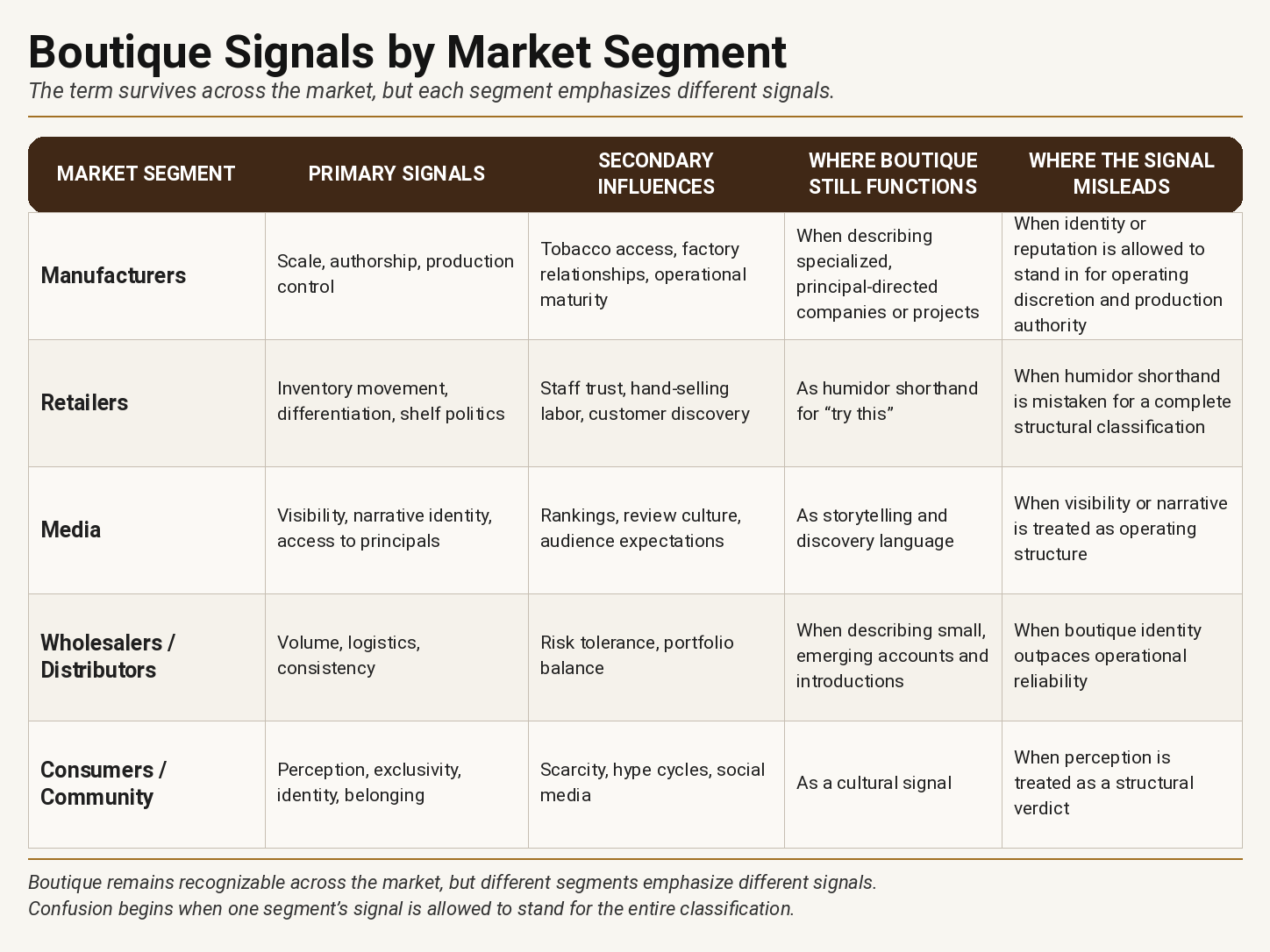
By this point, the disagreements across sectors no longer looked random. Manufacturers, retailers, and media contributors were not simply using boutique incorrectly. They were using it to describe different things.
Manufacturers generally approached the word from inside the company. Their concerns involved tobacco, production, scale, authority, identity, inventory, growth, manufacturing relationships, and operating control. Retailers approached it from inside the humidor, but the humidor turned out to be more than inventory. Their concerns involved shelf space, customer curiosity, recommendation, hand-selling, price, turnover, reorder behavior, supplier expectations, staff influence, clientele, and the identity of the shop itself. The owner may begin with a particular vision, but that vision is continuously reshaped by what customers request, what employees can sell, what manufacturers require, and what earns enough repeat business to remain. The retailer is therefore managing both merchandise and place.
Media and community voices approached boutique through meaning. Their concerns involved discovery, identity, accessibility, narrative, cultural attachment, scarcity, participation, and visibility. Wholesale and distribution added another pressure: durability. Their view was less concerned with how the cigar felt culturally and more concerned with whether the company behind it could support freight, warehousing, sales coverage, account service, margins, retailer commitments, and continuing movement.
The same word was therefore being asked to describe operating structure, purchasing experience, cultural meaning, commercial survival, and even the environment in which the cigar was encountered. That helps explain why people can use boutique every day without agreeing on what qualifies.
A retailer does not need a mathematically stable definition to tell a customer, “If you like that, try this smaller boutique brand.” A media outlet does not need production records to describe a release as part of the boutique scene. A consumer does not need an ownership chart to feel attached to a founder or to the community surrounding a cigar. A manufacturer, however, may hear the same word and think about factory size, tobacco access, independence, decision authority, or production volume. A distributor may hear it and immediately wonder whether the company can support the account after the first order.
The retail record adds another complication. The customer may encounter the cigar online, hear about it through media, purchase it through a national retailer, or discover it in a neighborhood shop. Those channels can overlap without providing the same experience. Online retail solves access. The brick-and-mortar shop provides place. That place can become part of the cigar’s meaning because the people, recommendations, relationships, and fellowship surrounding the product can affect how it is discovered and remembered.
The language stayed the same. The measurement changed with the room. The original twelve had raised the questions. Retail, media, community, wholesale, and distribution showed why those questions mattered outside that first circle. Now the manufacturer field had to become much larger.
SIGNAL, NOISE, AND STRUCTURE
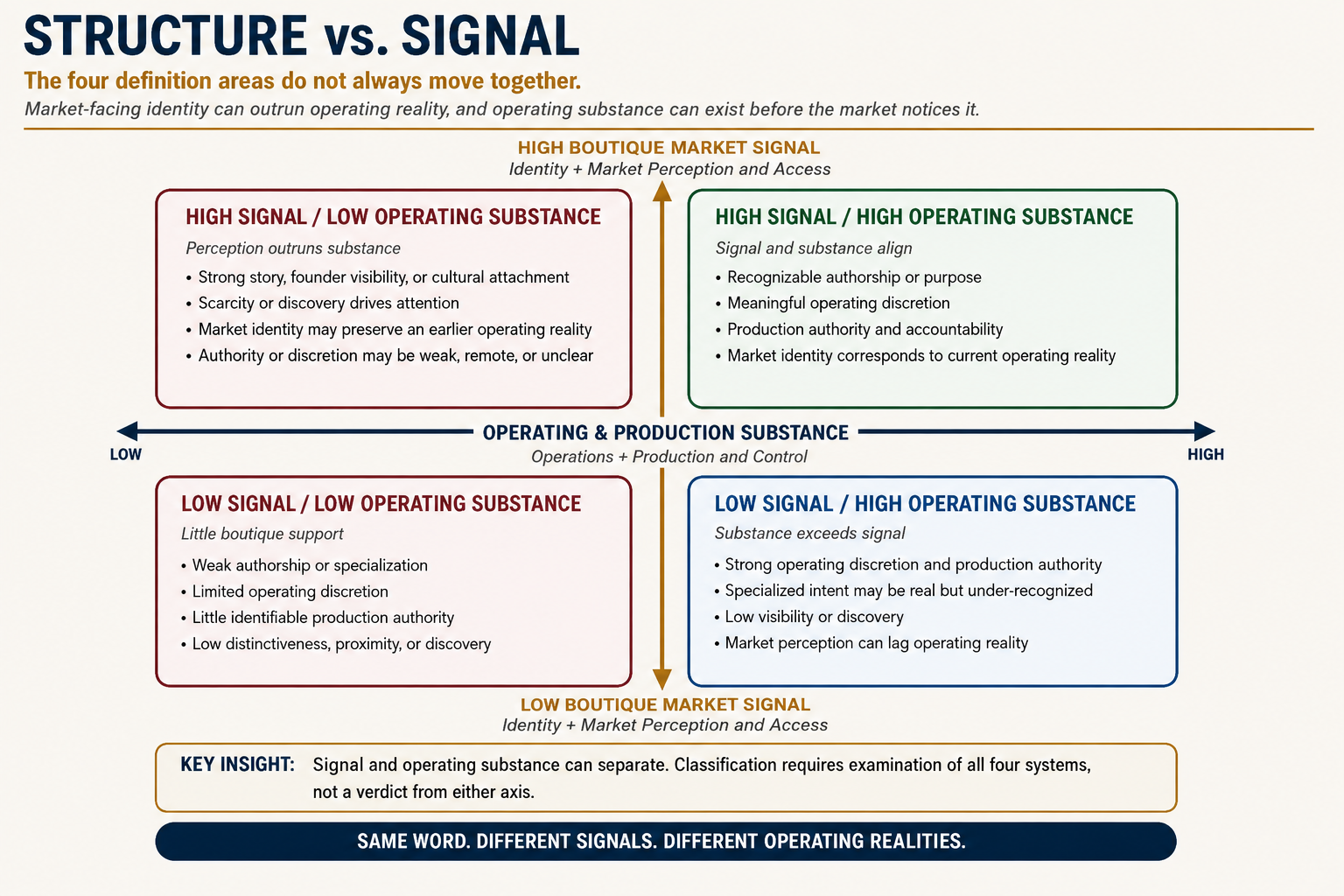
The differences among these groups suggest another way to understand why boutique has become difficult to use precisely. The signal remains strong: consumers hear intimacy, scarcity, personality, craftsmanship, independence, or discovery; retailers hear differentiation; media hear story and access; manufacturers may hear control, scale, tobacco, authorship, or independence. What changes is what each group believes the signal points toward.
Noise accumulates when association is allowed to substitute for evidence. Small production becomes craftsmanship. Scarcity becomes exclusivity. Founder visibility becomes authority. Limited distribution becomes restraint. Independence becomes authenticity. Social-media attention becomes cultural importance. None of those associations is necessarily false. None proves the underlying condition by itself.
Beneath both sits structure: what the company, brand, or cigar actually is. Who owns it? Who controls the blend and tobacco? Who can stop production? How broad is distribution? How close are the principals to the product, retailers, and consumers? Signal and noise explain how boutique is communicated; structure asks whether that communication still corresponds to operating reality.
That separation allows boutique to retain cultural meaning without forcing it to perform structural work. The retailer really does experience discovery and shelf differentiation. The consumer really does experience intimacy or exclusivity. The manufacturer really does confront questions of control and scale. The distributor really does confront volume and reliability. Trouble begins when one of those signals is promoted from a piece of evidence into the entire classification.
CHAPTER 24
MAKING THE ROOM BIGGER
The original twelve were a proximity sample. That description is important because I do not want to retrofit scientific neutrality onto a group chosen largely because they were close to my own experience. Their disagreement was significant, but another possibility had to be considered: perhaps the disagreement reflected the circle itself.
The next manufacturer phase deliberately widened the field. I wanted companies operating at radically different scales, companies that owned factories and companies that did not, vertically integrated manufacturers and contract-production brands, experienced veterans starting over, younger companies still building infrastructure, institutional brands, independent manufacturers, companies that deliberately limited growth, and companies whose cultural influence was larger than their physical footprint.
The first group had established a baseline through substantially similar questions. As specific disputes surfaced, later interviews became more targeted. Once factory ownership became a problem, there was little value in pretending every contributor needed the same generic question. Once experience, corporate platforms, cultural authorship, vertical integration, or deliberate scarcity became analytically important, the questions had to pressure those specific problems.
The process evolved from broad comparison into targeted stress testing. The purpose was not to recruit enough people to create consensus. It was to see whether the original disagreements survived a much harder comparison group. They did. Now the questions could take over.