ACT III — DOES THE LABEL ACTUALLY TELL US ANYTHING ABOUT QUALITY OR CRAFT?
CHAPTER 35
QUESTION 11 — IS BOUTIQUE ACTUALLY DIFFERENT FROM PREMIUM?
The premium cigar industry often talks about boutique as though the distinction is obvious: premium is one thing, and boutique is something more specialized. The problem is identifying what that additional word actually contributes. Premium already carries substantial meaning: a premium handmade cigar exists inside a category distinguished by tobacco, construction, fermentation, aging, blending, hand production, and a consumer expectation fundamentally different from cigarettes, machine-made cigars, or mass-market tobacco products. Once that is acknowledged, boutique has to do additional work.
Nicholas Melillo widens the lens enough to make the terminology almost absurd: "If you look at the broader tobacco industry, cigarettes, smokeless, and machine-made cigars, the entire premium handmade category is already boutique." His point is not that every premium cigar company should adopt the label, but that the entire handmade segment is already a niche when compared with the scale of the broader tobacco business. Context can make almost anything look small.
If it simply means handmade, premium already covers much of that territory; if it means quality, premium already makes that claim; if it means expensive, price has its own vocabulary; if it means limited, limited production can be measured directly; if it means independent, ownership can be examined directly; if it means small, production and distribution can be measured directly. Boutique therefore survives only if they communicate something premium does not. Michael Herklots approaches the distinction by refusing to treat boutique as a technical category: "'Boutique,' to me, is more of a mindset and an approach to business than it is a classification."
That sentence immediately separates boutique from premium. Premium describes a kind of product, whereas Michael Herklots is describing an approach. The difference is important because a cigar can clearly belong to the premium handmade category without requiring anybody to know the size of the company, the personality of its founder, the factory arrangement, the distribution footprint, or how the people behind it think about themselves.
A premium cigar can come from a tiny workshop, a family company with generations of history, or a multinational organization. The category does not collapse merely because the ownership structure changes. Boutique behaves differently because the word attempts to communicate information beyond the cigar's basic product category, asking the consumer to notice something about the organization around the cigar.
Michael Herklots has experienced that problem personally: Ferio Tego entered the market as a new company, but not with the innocence usually associated with a startup. Michael Herklots and his partners arrived with industry experience, relationships, professional reputations, and consumer expectations already attached to them. The company was small, but the perception surrounding it was not. That mismatch made the usual boutique storyline difficult to apply, letting Ferio Tego operate with the limitations of a founder-led young company while being judged through the expectations normally attached to something more established. Boutique, under those conditions, becomes less a measurable status than an interpretation of how the business operates. Billy Fakih, Co-Founder of Artesano Del Tobacco, approaches the question through company identity: "The term boutique encapsulates the essence of our company."
That is not a statement about whether El Pulpo qualifies as a premium cigar—its position in the premium handmade market already answers that. Billy Fakih attaches boutique to the organization itself: "We have built this operation from the ground up, prioritizing craftsmanship over mass production."
He also connects boutique with originality, branding, new blends, and collaborations intended to produce something distinctive. Again, the cigar remains central, but the boutique claim extends beyond it to describe what the company wants consumers to understand about the people, priorities, and decisions surrounding the product. The contrast suggests a potentially useful division: premium describes what the cigar is, while boutique attempts to describe the environment in which the cigar was conceived, produced, presented, or brought to market. That is not a perfect definition, but it is more useful than treating the words as synonyms. A premium cigar can be evaluated through recognizable physical and categorical characteristics, whereas boutique requires the observer to investigate something outside the cigar itself: Who made it? Who controls it? How large is the company? How broad is distribution? How involved is the founder? How unusual is the tobacco? How independent is the operation? How deliberately did the company choose its path?
Those questions are not necessary to determine whether a cigar belongs to the premium handmade segment; they become necessary only because boutique is trying to add another layer of meaning. The problem is that the industry has never agreed on which layer matters most.
Companies use boutique to signal different things: scale, independence, craft, personality, limited production, unusual tobacco, founder involvement, or simply distance from the industry's largest names. In practice, the word often behaves more like a modifier than a category, telling the consumer that something about a premium cigar should be understood as more personal, limited, unusual, or deliberately authored.
That expectation helps explain why boutique remains commercially useful even when it is analytically unstable. It adds discovery, personality, scarcity, or identity to the premium experience without reliably identifying which one.
A boutique cigar is not automatically more premium than another premium cigar. That sentence sounds ridiculous when stated plainly, but the market often behaves as though it were true. Once boutique becomes a superlative rather than a classification, the word begins implying that a smaller, more personal, or less institutional company somehow occupies a higher level of authenticity than the rest of the premium category. The evidence does not support that conclusion.
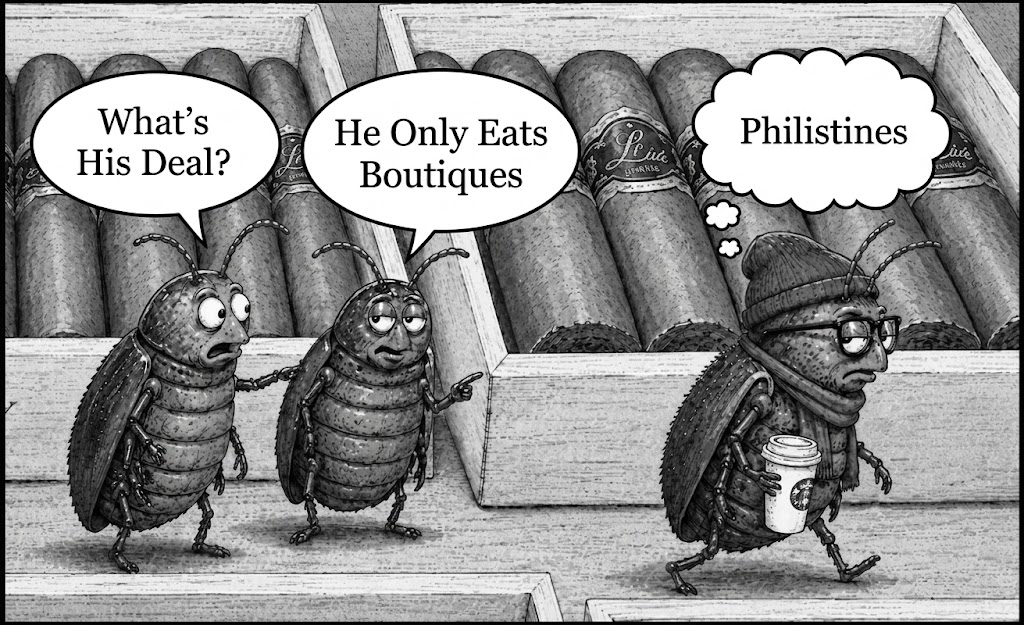
A large premium manufacturer can possess extraordinary tobacco, experienced blenders, disciplined fermentation, massive aging inventories, and decades of knowledge. A small company can possess almost none of those things. A small company can also produce extraordinary cigars through attention, flexibility, unusual tobacco access, and a willingness to pursue projects that would make little commercial sense for a much larger organization.
Those possibilities coexist. Premium and boutique therefore cannot be arranged as rungs on a ladder: premium is not below boutique, and boutique is not an upgraded version of premium. If boutique remains useful, its role must be descriptive rather than hierarchical. It should tell us something about the circumstances surrounding a premium cigar that the word premium alone does not communicate. Michael Herklots places that difference in mindset and business approach, while Billy Fakih places it in company identity, craftsmanship, originality, and the way the organization was built. Neither man is simply describing the cigar as premium; they are describing the human and organizational environment around it. That may be the clearest distinction available: premium tells us which world the cigar belongs to, and boutique tells us how somebody wants us to understand its place inside that world. Whether the second description can be measured consistently remains the problem.
CHAPTER 36
QUESTION 12 — DOES SMALLNESS TELL US ANYTHING ABOUT QUALITY?
Small has become one of the most flattering words in modern consumer culture: small batch, small producer, small farm, small brewery, small distillery, small company. People hear small and immediately begin supplying the rest of the story themselves: personal, careful, authentic, craft-driven, better. Human beings have apparently decided that square footage is a moral category. Premium cigars are especially vulnerable to this assumption because the handmade nature of the product already encourages romantic thinking. The smaller the factory, the closer the founder, the fewer the cigars, the easier it becomes to imagine that every leaf receives some level of personal devotion unavailable inside a larger operation. Sometimes that is exactly what happens; sometimes it is not. José Blanco, Worldwide Brand Ambassador for Arturo Fuente Cigars, reaches backward through cigar history to make the distinction: “The old cigar makers never called themselves boutique.”
That observation removes the modern terminology and leaves the traditional cigar standards underneath it: tobacco knowledge, blending patience, reputation, process, time, family involvement, discipline. None of those values were invented when the word boutique became fashionable. José Blanco's second line is even more useful: “The cigar always has to deliver.”
That is the standard smallness cannot escape. A small operation may have advantages: it may work with tiny tobacco lots that could never support national production, react quickly when something goes wrong, allow one person to remain involved in every important decision, experiment without needing a project to support millions of dollars in infrastructure, or cancel a cigar because the tobacco is wrong rather than force the project through because an annual plan demands another release. Those advantages are real.
Skip Martin, supplies the unpleasant reminder from the small-company side: “There are also dozens of small brands that do not consistently live up to the standard most people are speaking to.” That sentence should sit beside every romantic argument about scarcity or tiny production. Smallness creates possibilities; it does not issue a quality certificate.
They do not produce quality automatically. A small factory can ferment tobacco badly, a small company can release cigars too young, a founder can create an unbalanced blend, a limited production can be poorly constructed, a brand can lack the capital to hold tobacco long enough, or a tiny operation can substitute components because the original tobacco disappeared. The owner can personally supervise every mistake.
Erik Espinosa, maintains an operating standard that is far less interested in category: “I do things the right way, or I don’t do them at all.” Whether a company is small or large, that is the kind of claim the cigar can eventually test. It asks for execution rather than sympathy; proximity does not guarantee competence.
Law Ream pushes the same point to its logical limit. If boutique requires permanent small-scale limitations, the category starts rewarding weakness as though weakness were proof of craft. A classification associated with craftsmanship cannot require the absence of systems capable of improving the work.
Christian Eiroa reaches essentially the same conclusion without needing the boutique label at all. His vocabulary is older and more direct: “Everything matters.”
If everything matters, quality cannot be assigned to the size of the company; it has to emerge from the work itself: tobacco selection, fermentation, aging, blending, construction, the people performing the work, and the decisions made when something goes wrong. “ “Every step of the process is the most importantly part of the process.”
The wording is informal, but the principle is not. There is no stage in cigar production where quality suddenly appears. Quality accumulates through the process, and so do mistakes. Christian Eiroa is useful here precisely because he has little attachment to boutique as terminology while defending the standards people frequently associate with it. Henderson Ventura, Founder of ADVentura Cigars, provides the other half of the argument: “At ADVentura, being a boutique brand is not defined by size, but by intention, control, and a commitment to every detail.”
Henderson Ventura then makes that philosophy measurable through his own role: “As the founder, I also serve as the master blender, and I am present in the factory every day, directly involved in production.”
That is very different from simply saying the company is small. Henderson Ventura describes behaviors: presence, control, blending authority, attention to detail, respect for tobacco. He also emphasizes the time tobacco requires: “It means having real control over what we create, respecting the time required by the tobacco, and delivering an authentic experience in every cigar.”
Those conditions can affect quality, but the number of employees does not. Boutique language often bundles size and quality together. A company is small, therefore it must be hands-on; it is hands-on, therefore it must care more; it cares more, therefore the cigar must be better. Each step feels reasonable, but none follows automatically from the one before it. A company can be small because the founders intentionally restrict production, because it is new, because it has limited financing, because demand never increased, because its tobacco supply physically limits output, or because the owners have no interest in growing. Those are completely different reasons for arriving at the same production number, and only some have any relationship with quality. The same mistake occurs with scarcity.
A cigar can be scarce because there were only a few bales of tobacco capable of producing it, which tells us something real about the product. A cigar can also be scarce because a company ordered two thousand boxes, printed Limited Edition on the packaging, and correctly predicted that consumers become anxious when somebody tells them an object may disappear. That tells us something real about marketing; the two should not be confused.
Small production can create opportunity for quality. A maker may use specialized tobacco that would be impossible in a larger line, a company may tolerate variation that a national brand cannot, or a blender may have greater freedom to build around one unusual component without worrying about supplying the same cigar for a decade. Smallness can also create quality problems. Tobacco inventory costs money, aging costs money, mistakes cost money, rejected production costs money, and holding multiple years of a component costs money. Consistency across agricultural variation requires both knowledge and inventory depth. A company with fewer resources may face harder choices when those pressures arrive. None of this diminishes the value of small manufacturers; it makes their accomplishments more impressive when they overcome those limitations. But admiration should follow the cigar.
José Blanco's safeguard remains the cleanest: the cigar has to deliver. Henderson Ventura describes the work that can help it do so: control, intention, detail, time, presence. Those are practices, not synonyms for small. Separating practice from size also protects growing companies from the assumption that every added employee, inventory investment, distribution expansion, or quality-control system represents distance from the craft.
Growth can damage quality when the company outruns the tobacco, people, systems, or judgment supporting it. It can also improve quality by reducing the vulnerabilities of an under-resourced operation. The meaningful question is what changed: tobacco, aging, consistency, decision-making, founder involvement, commercial pressure, or the ability to reject a compromise.
Those are quality questions, but head count is not. Smallness can create intimacy, flexibility, experimentation, accountability, or fragility. The cigar still has to prove the rest. Small is a condition; quality is an achievement.
CHAPTER 37
QUESTION 13 — CAN SCALE AND INFRASTRUCTURE STRENGTHEN CRAFT?
The romantic boutique story usually has a villain: growth. At first the company is small, passionate, personal, and focused entirely on the cigar. Then success arrives. Production increases, distribution expands, employees appear, systems are built, warehouses fill, sales forces grow, and meetings multiply. The cigar, according to the story, never recovers. There are certainly companies that have grown into mediocrity, but there are also companies that remained small and achieved it without assistance. Scale is not the moral variable. Nicholas Melillo, Founder of Foundation Cigar Company, approaches the issue from the physical realities of tobacco: “Where ‘boutique’ becomes misleading is when it is tied to quality or consistency.”
That statement becomes more significant when he explains what consistency actually requires. Daniel Lance, Founder of Domain Cigars, describes the business consequence in equally unsentimental language: “Without that, a brand remains an idea. “With it, a company becomes durable.” Durability requires more than a good blend. At scale, the company has to build enough operating structure for the idea to survive its own success. “ “From a blending standpoint, consistency comes down to access: tobacco supply, aging, and inventory depth.”
Those are not romantic concepts; they are resources. Premium cigar tobacco is agricultural inventory that may need to be purchased years before the consumer ever sees the finished cigar. The tobacco must be grown, harvested, cured, fermented, sorted, stored, aged, protected, and somehow predicted. A company blending a cigar today may need to think about what tobacco will be available several years from now if that cigar becomes successful.
The smaller the organization, the more difficult that problem can become. A small brand may find an extraordinary tobacco and build an exceptional cigar around it, which is one of the genuine creative advantages of small production. The same company may have enough of that tobacco for eighteen months. Then what? The blend changes, the cigar disappears, or another crop is substituted. The company purchases what is available rather than what is ideal.
That does not necessarily reflect poor judgment; it may simply reflect limited purchasing power and inventory depth. A larger or more established company can sometimes do something the romantic boutique story rarely credits: it can wait. Capital can buy time. A company with deeper resources can purchase enough of a tobacco to support years of production, hold inventory longer, or reserve tobacco from multiple crops.
It can reject a shipment without immediately threatening the entire line. It can absorb the financial cost of aging tobacco rather than converting that inventory into revenue as quickly as possible. It can employ people whose entire responsibility is fermentation, quality control, agriculture, or blending. Those are not enemies of craftsmanship.
Tom Lazuka, Co-Founder of Asylum Cigars, describes infrastructure from the creative side rather than the defensive one: “It really gives us a lot of freedom to be creative and provide a first-class product at the same time.” That is the inversion boutique mythology often misses: more capability can create room to experiment rather than eliminate it.
They can be instruments of it. Infrastructure can protect patience, inventory can protect consistency, and capital can protect a blend from being altered merely because one component becomes difficult to acquire. Scale can give craftsmen more options, though none of that means they will use them well. David West, Founder of Avowed Cigar Company, supplies the necessary warning: “Production access and various sales/distribution channels may quickly become an anchor instead of a propeller.”
Access creates temptation. A new company with strong factory relationships, distribution opportunities, retailer interest, experienced founders, or easy production access can grow faster than an older boutique company ever could. That sounds like an advantage, but it is an advantage only if the company is prepared to carry what the advantage creates. More production requires capital, more accounts require inventory, and more distribution requires service.
More markets require sales support, more tobacco commitments require forecasting, and more SKUs require attention. Every opportunity creates another obligation somewhere else in the system. David West's warning is useful because it prevents the scale argument from becoming its own mythology. Infrastructure is not automatically strength; it can become weight. A company can have too many production opportunities or too many releases.
Scale magnifies capability and mistakes. Infrastructure tells us what an organization can do; it does not tell us what it chooses to protect. If warehouses allow longer aging, deeper inventory prevents unnecessary substitution, quality-control staff catch problems, or financial stability lets a company cancel bad production, the infrastructure serves the cigar.
A company with poor judgment can waste either condition. The presence of infrastructure tells us what an organization is capable of doing; it does not tell us what it chooses to protect. That is the decisive question: what does the infrastructure serve? If the warehouse allows tobacco to age longer, the infrastructure serves the cigar. If deeper inventory protects a blend from unnecessary substitution, the infrastructure serves the cigar.
If experienced quality-control personnel catch problems before they reach retailers, the infrastructure serves the cigar. If greater financial stability lets a company cancel a production rather than ship something it does not believe in, the infrastructure serves the cigar. If agricultural investment gives the blender more control over varieties, fermentation, and long-term supply, the infrastructure serves the cigar.
The relationship can reverse. Payroll, sales forces, distribution networks, retail programs, annual targets, and unused production capacity create demands of their own. At some point the machine can begin asking the cigar to serve it through easier-to-scale blends, broader tobacco specifications, or releases dictated by calendar rather than readiness.
That pressure is not unique to large organizations, but larger infrastructure can magnify it. Nicholas Melillo shows what scale can protect: tobacco supply, aging, inventory, consistency. David West shows what it can threaten: focus, patience, financial discipline, operational control. Resources expand choice; they do not make the choices.
A mature manufacturer can therefore remain extremely close to its cigars despite having more people, systems, tobacco, and layers. A founder may personally inspect tobacco because nobody else is available; a larger company may employ specialists with decades of experience whose only responsibility is protecting that standard. The more useful question is not which arrangement looks more boutique, but which produces better control.
Craft and infrastructure are not natural enemies. Limited resources can inspire creativity or expose fragility; repeatable systems can look less romantic while preserving consistency. The difference is what the machine has been built to serve. If infrastructure protects the cigar, scale can strengthen craft. If the cigar is changed primarily to protect the infrastructure, the relationship has reversed.