ACT V — WHAT HAPPENED TO THE WORD?
CHAPTER 41
QUESTION 17 — WHAT DOES THE BOUTIQUE LABEL ACTUALLY DO?
A label does not have to classify perfectly to be useful. That may explain boutique better than any definition considered so far. The word has survived despite disagreement over size, ownership, manufacturing, distribution, independence, quality, culture, growth, control, and almost every other characteristic attached to it. A completely useless term should eventually disappear, but boutique has not. So, it must be doing something. Casey Haugen, Vice President of CRUX Cigars, exposes the problem almost accidentally: “I would love for someone to tell me what boutique means...”
Then he asks the questions everybody eventually reaches: “Is it a number of cigars? “The ambiance of the brand? “Or just a mindset.”
Casey Haugen is not struggling because he lacks familiarity with the cigar business; his experience is exactly what makes the uncertainty valuable. Once somebody starts trying to establish an actual boundary, the category becomes slippery. If boutique means small production, how small: ten thousand cigars, one hundred thousand, five hundred thousand, a million, or several million? If boutique means independence, does contract manufacturing disqualify the company? If boutique means hands-on, how much involvement is enough? If boutique means limited, what creates the limitation? If boutique means mindset, the measurement problem becomes even worse because mindset cannot be audited from a production report.
Yet the word remains immediately recognizable, which creates the core paradox: boutique may be weak as classification while remaining powerful as communication. The word creates an expectation before anyone establishes the underlying facts.
James Brown, Founder of Black Label Trading Company and Black Works Studio, explains why that expectation can become belonging: “When the brand isn’t for everyone, the people that do relate or understand it feel more exclusive and it creates this ‘boutique’ aura. “People feel like they are a part of something.” That is not a production definition at all; it is a description of affiliation. The label can help turn a product into a small social territory consumers feel they discovered and understand.
A consumer hears boutique and may expect something smaller, more personal, less corporate, more specialized, more difficult to find, more connected to the founder, more experimental, more independent, or possibly better. None of those characteristics is guaranteed, but the label points the consumer toward that general territory. That makes boutique less like a technical category and more like a signal.
Jon Huber, Co-Founder of Crowned Heads Cigars, describes one of the strongest human signals attached to the word: “More often than not, boutique applies to brands that usually have a front-of-house ‘face,’ so to speak, as opposed to corporations that rely on a boardroom of nameless suits whose objective is to generate revenue, regardless of the brand or product.” The contrast is intentionally sharp, but it identifies what many smokers are actually reacting to: a visible author rather than an invisible institution.
Erik Espinosa, President of Espinosa Premium Cigars, provides a particularly useful example because his own relationship with the term has never depended on finding a production number that settles the argument. Asked whether there really is such a thing as a boutique cigar company, Erik Espinosa questioned the measurement immediately: “I don’t know what that means. “Do you define it in the number of sales?”
He then pushed the problem further: “There you go, but how small? “Is it a numbers thing?”
Those are the same difficulties Casey Haugen identifies. But Erik Espinosa’s newer observation explains why the label can retain meaning even after the numerical definition collapses. For him, one of the expectations attached to boutique is personal involvement: “Absolutely. “We built our business on social media and proximity. “I take calls from people that have been with us from day one. “How can I turn my back on the people that got us to where we are?”
That answer moves the discussion somewhere production numbers cannot reach: proximity. Espinosa Cigars is no longer an unknown company fighting for its first accounts. Growth has changed the scale of the business, but growth has not necessarily erased the relationship consumers associate with the company. Erik Espinosa still sees value in direct contact with people who supported the brand from the beginning, not because continued access is some grim duty imposed by success, but because being able to maintain those relationships is a privilege. The privilege itself says something important about what consumers may actually be responding to when they use boutique. They may not be measuring production at all; they may be measuring distance.
Mo Maali, Founder of Patina Cigars, makes that distance transactional in the best sense of the word: “Standing by your product with the people who spend their money on your cigars gives a face to the brand and establishes a connection.” The smoker is not merely buying access to the founder; he is seeing somebody willing to stand beside the product after the sale.
How far is the smoker from the person whose name, personality, decisions, or reputation sits behind the cigar? Can the consumer meet that person, talk to him, send a message, see him at an event, ask about a blend, or feel that the person responsible for the product remains reachable after the company becomes successful? Those experiences can shape boutique perception far more strongly than a factory production report.
Sam Phillips, President of La Palina Cigars, adds a useful distinction between curiosity and attachment: “Most consumers are interested in who made the cigar. “The most passionate consumers are interested in why the cigar exists in the first place.” That shift from who to why is where brand identity begins doing work that factory identification cannot do alone.
The industry frequently assumes that growth and proximity move in opposite directions. Sometimes they do. A founder who once handled every retailer relationship eventually needs employees, while a company that once answered every message may accumulate more consumers than any one person can reasonably know. Distribution expands, responsibilities multiply, and layers appear because organizations require them. That is normal growth.
But distance is not determined entirely by head count. A company can become larger while deliberately maintaining direct points of connection, whereas another can remain tiny while feeling completely inaccessible. Size and proximity overlap sometimes, but they are not the same measurement. Erik Espinosa’s answer helps explain why consumers may continue calling a company boutique after someone examining only annual production decides that the label no longer fits.
The consumer may be measuring the relationship. That does not mean the consumer is analytically correct; it means the consumer is responding to something real that the usual classification debate has failed to isolate. Casey Haugen shows us that the label lacks an agreed boundary, while Erik Espinosa shows us why people keep using it anyway. It communicates a bundle of expectations, not guarantees. The expectation-versus-guarantee split is critical.
Oscar Valladares, Founder of Oscar Valladares Tobacco & Co., makes that distinction explicit: “Boutique identity has more to do with authenticity, closeness, and consistency in a brand’s philosophy than simply the number of boxes you produce.” His point helps explain why the label can survive after scale changes. Consumers may be measuring continuity and distance, not merely volume.
A label can influence what a consumer looks for before the consumer knows enough to verify it. Call something boutique and the smoker begins searching for intimacy, individuality, scarcity, authorship, or difference. Sometimes the company provides those things, sometimes the cigar provides some of them, and sometimes the marketing provides all of them before the operation provides any. That is where the label becomes commercially valuable.
Retailers can use boutique as shorthand for products outside the most familiar legacy brands, media can use it to organize a group of smaller or independent companies without explaining every ownership and production relationship each time, and consumers can use it to describe cigars that feel less institutional or more discoverable. Manufacturers can accept it because the word suggests characteristics they want associated with the company. The label therefore performs work even when it fails to classify with precision.
Billy Fakih, Co-Founder of Artesano Del Tobacco, treats visual identity as part of that work: “Our branding is crafted to be unique and original.” There is nothing trivial about that. Before a smoker knows the factory arrangement, tobacco inventory, or annual production, he sees the box and band. Boutique often reaches the consumer visually before it reaches him analytically, giving him an initial point of orientation.
Michael Szczepankiewicz, Co-Founder of Powstanie Cigars, supplies the necessary limit: “All of those things simply magnify who you are and what the company represents as a whole.” Visibility can amplify identity, but it cannot create a durable one from nothing. The label may point the consumer toward the brand, but eventually the company has to provide something worth magnifying.
It tells the consumer where to look: there may be something different here, or the company may be smaller.
Jeremy McDonald, Founder of Wildfire Cigars, states the modern pressure on a small brand with no romance at all: “If you’re not engaging with smokers and creating real connection, you’re invisible.” That helps explain why the label continues to matter. In a crowded humidor, communication is not decoration; it is part of being found.
The founder may be closer, the cigar may be unusual, the production may be limited, or the identity may be more personal: investigate further. That is a useful market function, but it is not the same thing as a definition. Casey Haugen cannot establish exactly where boutique begins, and Erik Espinosa cannot provide a production number that settles it. The market continues using the word because perhaps that was never its most important function. Boutique does not necessarily tell the consumer what a company is; it tells the consumer what kind of company to imagine. And once that imagination carries commercial value, the next problem becomes unavoidable.
CHAPTER 42
QUESTION 18 — WHEN DOES BOUTIQUE BECOME MARKETING?
There is nothing inherently suspicious about marketing a cigar. A company that refuses to tell anybody what it makes will eventually discover one of capitalism’s less mysterious principles: people rarely buy products they do not know exist. Cigar companies advertise, hold events, tell stories, design packaging, work with retailers, use social media, seek reviews, launch new products, and explain why consumers should care. None of that corrupts a cigar. The relevant question is not whether boutique is used in marketing; the question is when the marketing value of the word becomes more important than whatever operating reality it is supposed to describe. Oliver Nivaud, National Sales Manager for United Cigars, identifies that separation clearly: “The market has matured to the point where consumers and retailers are looking deeper than labels.”
That alone suggests the label has lost some of the authority it once carried. Consumers know more, retailers know more, factory relationships are discussed more openly, production arrangements are easier to investigate, and brand owners communicate directly with smokers. A company can no longer assume that a single adjective will explain the operation. Yet Oliver Nivaud does not argue that boutique has become commercially useless: “The term still has marketing relevance, but it’s no longer a precise indicator of a company’s long-term viability.”
Those two ideas belong together. Boutique can remain valuable in marketing after it stops functioning reliably as classification. That is exactly why the word deserves scrutiny. If a label creates desirable expectations, companies have an incentive to use it. Boutique can suggest independence without proving ownership, scarcity without explaining what caused the scarcity, personal involvement without showing where that involvement occurs, unusual tobacco without identifying anything unusual, or craftsmanship without telling the consumer how the cigar differs operationally from another premium handmade cigar. The word does not have to make a false statement; it can simply allow the audience to complete the sentence. That is efficient marketing.
Oliver Nivaud’s broader diagnosis is even less flattering to the category: “The term alone has a major identity crisis and no longer clearly defines a company or production.” Once the noun itself becomes unclear, the adjective can be moved almost anywhere a company finds it useful. That flexibility is excellent for marketing and terrible for classification.
Michael Szczepankiewicz approaches the problem through identity: “When I hear the word boutique it sounds to me like a brand that is trying to find their identity.”
Boutique can become a substitute for saying what the company actually is. Instead of describing the identity directly, the label asks the consumer to supply one from familiar associations: small, independent, authentic, personal, craft, or different. Those are attractive ideas, but they are also easier to claim collectively through one word than to demonstrate individually. Michael Szczepankiewicz offers a harder standard: “Authenticity and reputation. “These are the two simple components that will establish a brand’s identity.”
Neither can be declared into existence. A new company can create branding immediately, packaging immediately, social-media accounts immediately, and visibility surprisingly quickly. Reputation takes longer because reputation requires a record. Did the cigars perform? Did the company support retailers? Did quality remain consistent? Did consumers come back? Did the company behave the same way after success arrived? Did the people behind the brand remain what they claimed to be? Time answers those questions.
Ernesto Pérez-Carrillo, Founder of Casa Carrillo, explains why the pressure to establish identity has accelerated: “Communication and brand marketing happen instantly now.” Reputation still requires time, but introduction no longer does. A new brand can become visible before the market has accumulated enough experience to know what the visibility is worth.
Marketing cannot answer them in advance. Michael Szczepankiewicz makes the distinction explicit: “Authenticity and reputation are earned over time. “They are not created because a company calls itself boutique.”
That may be the cleanest point at which boutique crosses from description into positioning. A company describes itself when the language corresponds to observable characteristics; a company positions itself when the language is selected primarily because of what the audience is expected to infer. The same word can perform both functions. A small founder-led company may use boutique because it believes the term reasonably communicates its scale, independence, involvement, or specialized approach.
That is not inherently deceptive. A retailer may use boutique because customers understand it as shorthand for unfamiliar or specialized products, which is practical language. A writer may use boutique because the industry lacks another broadly understood umbrella term. Imperfect language is not dishonest language. The problem begins when the suggestion becomes more valuable than the substance underneath it.
Steve Saka, Founder of Dunbarton Tobacco & Trust, is characteristically less diplomatic: “Anyone using this as a marketing pitch is missing the point: they should aspire to craft exceptional puros, provide professional account management and superior customer service.” His objection is not to selling cigars; it is to allowing the descriptor to become a substitute for the things a cigar company is actually responsible for doing.
A company knows consumers associate boutique with scarcity, so it creates scarcity as theater.
Andre Farkas, Founder of Viaje Cigars, describes the corporate version directly: “While larger conglomerates may co-opt the term by launching so-called ‘boutique’ lines within vast portfolios to suggest exclusivity, true boutique status demands a fundamentally different approach.” Whether one accepts his final definition or not, the marketing mechanism is clear: a company can borrow the emotional signal of smallness without becoming small.
A brand knows consumers associate boutique with personal involvement, so it builds a founder personality far larger than the founder’s actual relationship with production.
Dion Giolito, Founder of Illusione Cigars, describes the elasticity from the other side: “But cigar companies have taken the word ‘boutique’ and worked it into an approach that fits a specific, targeted narrative within their operation, whether they are a multinational, billion-dollar company or a small business producing a relatively small amount of product and revenue.” At that point the word is no longer measuring one condition; it is being tailored to the story each company needs it to tell.
A company knows consumers associate boutique with small production, so it emphasizes one tiny release while allowing the audience to form conclusions about the entire organization. A cigar is called boutique because the word sounds more desirable than small, unknown, contract-produced, or difficult to find.
Nick Perdomo Jr., President of Perdomo Cigars, looks at that experimentation from the retailer’s side, where unsuccessful positioning has a cost: “They take up shelf space and if the brands don’t sell. “They tie up cash flow from the retailer.” Boutique may sound romantic at the brand level; at the humidor level, every experiment occupies inventory somebody had to pay for.
Christian Eiroa, Founder of CLE Cigar Company and Eiroa, strips away another layer of marketing language: “The cigars have to earn their keep.”
There is not much romance in that sentence, which is why it belongs here. A cigar can arrive with a story, attractive packaging, a respected founder, limited production, and every other signal the market associates with boutique. Eventually the retailer has committed money and shelf space, the consumer has paid for the experience, and the product has to justify remaining there. Marketing can earn attention and create curiosity, helping secure the first order or the first light, but it cannot indefinitely protect a cigar that fails to earn its place.
Matt Booth, Founder of Room101 Cigars, in a Cigar TV discussion, reduced the market’s aesthetic shortcut to a phrase that requires no translation: “shit that looks different.” Crude, yes, but also useful. Packaging can become a visual proxy for boutique even when the actual production would never satisfy a more demanding definition.
Nothing has necessarily been lied about; the problem is unsupported suggestion. Marketing should present the strongest legitimate case for the product. Unsupported suggestion lets the audience infer qualities the company cannot demonstrate or does not want examined.
Identity still matters in a crowded market, but it should eventually become more specific than boutique. Who controls the cigar? What is different about the tobacco or process? What relationships are protected? What reputation has been earned? Boutique can introduce those questions, but it cannot answer them.
Lew Rothman, Founder and Former CEO of JR Cigars, has seen the same commercial migration before. His earlier observation about limited editions is the warning here: once a differentiation label proves commercially useful, the market can reproduce the signal faster than it can preserve the distinction. Scarcity language eventually becomes another form of abundance. A company begins small, the market calls it boutique, it grows, distribution expands, and production expands. As companies grow, language can lag behind operating reality. Sometimes that is innocent; sometimes it is commercially convenient. Marketing begins where the convenience becomes intentional.
The better standard is correspondence. If boutique implies smallness, explain the scale; if it implies independence, explain the ownership; if it implies hands-on involvement, show the involvement; if it implies limited production, explain what creates the limitation; if it implies unusual tobacco or process, identify what is unusual; and if it implies authenticity, allow time and behavior to prove it. Boutique becomes marketing when the word is used primarily for the attractive assumptions surrounding it. It becomes misleading when those assumptions no longer correspond reasonably to the company behind them. Marketing is not the problem; the problem begins when the label is doing more work than the company.
WHEN MYSTERY STARTS DOING THE WORK
Mystery has always had a place in premium cigars. Not every manufacturer wants to disclose every component, production relationship, tobacco source, or factory arrangement, and there can be perfectly legitimate reasons for keeping some of that information private.
The problem begins when mystery itself becomes part of the value proposition. The undisclosed factory becomes intrigue; the undisclosed blend becomes sophistication; limited information becomes evidence of exclusivity. Eventually, the absence of information is asked to do the same work that authorship, control, specialization, and tobacco knowledge were supposed to do.
That is another way boutique can drift from description into marketing. A cigar does not become more boutique because the company refuses to say where it was made or what went into it. Nor does a high price establish exclusivity, and a large production run does not become meaningfully limited simply because the word limited appears on the box.
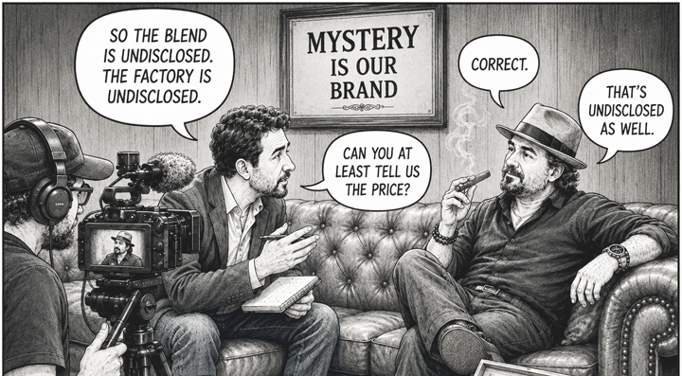
There is something backwards about spending more time defending the price of a cigar or explaining why 10,000 boxes should still be considered “limited” than actually promoting the cigar itself. When the conversation becomes an argument over price, scarcity, terminology, and perception, the product has already been pushed into the background. The cigar should be the easiest part of the story to defend.
Secrecy may create curiosity, price may create prestige, and scarcity may create urgency, but none of those things proves meaningful production authority, independence, specialization, or restraint. Mystery can support an identity, but it should not be allowed to substitute for one.
CHAPTER 43
QUESTION 19 — WHAT DO SMOKERS GET WRONG ABOUT BOUTIQUE?
Smokers are not wrong to use shortcuts. Investigating every cigar company at the level required by this paper would turn an evening hobby into unpaid forensic accounting. People need shorthand, retailers need shorthand, and writers need shorthand. The problem begins when shorthand is mistaken for a complete set of facts.
That confusion did not originate with consumers. Manufacturers, retailers, distributors, media, and marketers have used boutique to describe different things while attaching the same favorable qualities to it. Consumers did not create the confusion. The industry handed them the word, loaded it with implications, and never agreed on what those implications proved.
That statement challenges the consumer who treats scale as a simple on-off switch where small equals boutique and large equals not boutique. Finished. The evidence throughout this paper has refused to cooperate with that tidy arrangement.
Pete Johnson, Founder of Tatuaje Cigars, now sounds less certain about the category than the market often sounds on his behalf: “I don’t know what the definition is anymore.” Coming from somebody whose company helped shape the modern boutique conversation, that uncertainty is evidence in itself. Familiarity with the category has not produced a cleaner boundary.
Oscar Valladares addresses one of the resulting assumptions directly: “As long as the founder and the team maintain a real connection to the product and to the consumer, that essence can remain intact even as the company grows.”
Growth changes a company, and it would be foolish to pretend otherwise. More cigars require more tobacco, more retailers require more service, more employees require more organization, and more markets require greater coordination. Systems appear because improvisation stops working. The founder who once knew every account personally eventually encounters the physical limitations of being one human being. Something changes. But consumers often make a second leap that does not necessarily follow: assuming that if the company became larger, everything they associated positively with its earlier stage must have disappeared. Oscar Valladares rejects that. Authenticity can survive growth, closeness can survive growth, a consistent philosophy can survive growth, and founder involvement can survive growth. The manner in which those characteristics are expressed may change, but scale does not automatically erase them. This is one reason consumers disagree so dramatically over mature companies.
One smoker looks at annual production and says the company obviously stopped being boutique years ago. Another interacts with the founder, knows the company’s history, recognizes its philosophy, follows the products closely, and insists that the company still feels boutique. They are measuring different things.
Pete Johnson also identifies one reason those measurements drift: “I think that Tatuaje as a brand, visually, people think it’s bigger than it really is.” Visibility, ratings, founder recognition, and cultural presence can make a company feel structurally larger than it is. Consumers often measure the footprint they see, not the operation behind it.
Neither realizes the argument began before either of them opened his mouth. Nimish Desai, Industry Principal at Rocky Patel Premium Cigars, provides the historical complication. Asked whether Rocky Patel began as a boutique cigar company, his preserved answer is wonderfully unambiguous: “Hell yes, we were boutique. “We were all boutique.” That line exposes another consumer shortcut.
Lew Rothman locates part of the shift in the audience itself: “It changed because the consumer has changed.” Greater access to information did not merely educate cigar smokers; it expanded the number of things they expected to discover, compare, discuss, and distinguish from one another.
Boutique and legacy are often treated as opposite categories: legacy is old, established, large, recognized, and permanent, while boutique is young, small, independent, discoverable, and emerging. That contrast works reasonably well if the consumer freezes the industry at one moment in time. Companies, unfortunately, insist on continuing to exist. Young companies age, unknown companies become known, small companies grow, founders build organizations, retail relationships accumulate, and factories expand. Consumers who discovered a brand before everyone else eventually have to endure the indignity of everyone else discovering it too. At some point, yesterday’s boutique company becomes today’s established company. Nothing magical happened; time passed. Nimish Desai’s answer makes that visible. The companies consumers now regard as established did not enter the market fully formed with national distribution, large inventories, experienced sales organizations, and decades of consumer recognition.
They built those things. Many started with characteristics that a modern smoker would immediately associate with boutique: limited distribution, founder involvement, direct retailer relationships, smaller production, personal reputation, a fight for recognition, and a dependence on word of mouth. If those companies had launched today under similar circumstances, the market would almost certainly place many of them inside the boutique conversation.
That suggests legacy may sometimes be less an opposite of boutique than a possible destination for companies that survive long enough. Not every boutique company becomes legacy, as most companies in any competitive business do not survive indefinitely. And not every established company began under identical conditions; history refuses to be that cooperative.
Lew Rothman’s analogy is deliberately ordinary: “How many kinds of beer, potato chips, frozen dinners….. virtually anything you can name now occupy space on retail shelves today, why should cigars be any different?” The premium cigar market did not evolve in isolation. Consumers across categories became accustomed to choice, specialization, novelty, and constant differentiation. Boutique grew inside that larger appetite.
But treating boutique and legacy as fixed opposing species ignores the lifecycle of actual businesses. That is only one of the things smokers get wrong. Another is assuming boutique means better, though earlier sections already dismantled that idea: small production creates possibilities, but it does not create competence. Another mistake is assuming scarcity means intentional restraint: a cigar can be scarce because the tobacco limits production, or because somebody decided scarcity would help sell it. Another is assuming independence guarantees greater creative control: sometimes it does, but sometimes limited capital creates pressures a larger organization does not face. Another is assuming corporate involvement automatically eliminates personality: it can, but it can also provide infrastructure that allows a distinct brand to operate with greater resources. Another is assuming personal visibility means manufacturing authority: a founder can appear everywhere while controlling surprisingly little about the cigar, whereas a less visible operator may control everything from tobacco selection through final production.
The label encourages the consumer to bundle these characteristics: small, independent, hands-on, scarce, authentic, craft-driven, high quality, founder-led, and different.
The industry has repeatedly shown that those characteristics can move independently, which creates the largest consumer misconception of all. The biggest thing smokers get wrong about boutique is not believing that boutique means small, independent, or limited—those are understandable interpretations. The larger mistake is assuming everybody else is using the word the same way.
One smoker says boutique and means production; another means ownership; another means discovery; another means founder personality; another means unusual tobacco; another means limited distribution; another means independent spirit; and another simply means something outside the large familiar brands occupying most of the humidor. The conversation functions perfectly well until somebody names a company, and then the hidden definitions collide.
One person insists the company is boutique, while another laughs at the idea. Both may possess accurate facts; they simply assigned different facts authority over the word. The boutique debate can become strangely emotional because people believe they are arguing over companies when they are often arguing over definitions they never stated. Oscar Valladares reminds us that the characteristics consumers value can survive growth. Nimish Desai reminds us that the companies now viewed as established once had beginnings too.
Together they expose the danger of treating a company’s current market position as though it describes its entire history or philosophy. The smoker should not abandon the word boutique, because the word still communicates something. It creates curiosity, signals difference, and can identify a general region of the premium cigar market worth exploring.
But it should create a question rather than provide an answer. Boutique according to what: size, ownership, control, production, culture, proximity, distribution, or history? Once that second question is asked, the conversation becomes much more useful. The label can influence the first sale; eventually the cigar has to create the second. And after nineteen questions, the final one becomes unavoidable: if the industry can identify all of these characteristics individually, what happens when we stop asking which of them qualifies as boutique? What remains when the word itself is removed?